Das weltweite Magazin und der Marktplatz für Oldtimer-Enthusiasten – von Enthusiasten.
Das weltweite Magazin und der Marktplatz für Oldtimer-Enthusiasten – von Enthusiasten.


Filter
Auswahl treffen
- Autos
-
Marke >>
-
Baujahr >>
-
-
Kategorie >>
-
Länder >>
- Motorräder
- Teile
-
Automarke >>
-
Hersteller >>
-
Kategorie >>
- Fahrräder
-
Baujahr >>
-
Länder



The Musée des Blindés de Saumur presents the Panther tank and, in a live demonstration, the AMX 10 PAC 90 amphibious tank



Press release
The Musée des Blindés de Saumur holds one of the world’s largest collections of armoured vehicles from the First World War to the present day. This institution not only represents a very substantial technical heritage, but also perfectly fulfils its mission with regard to the memory of France in combat which is part of our history.
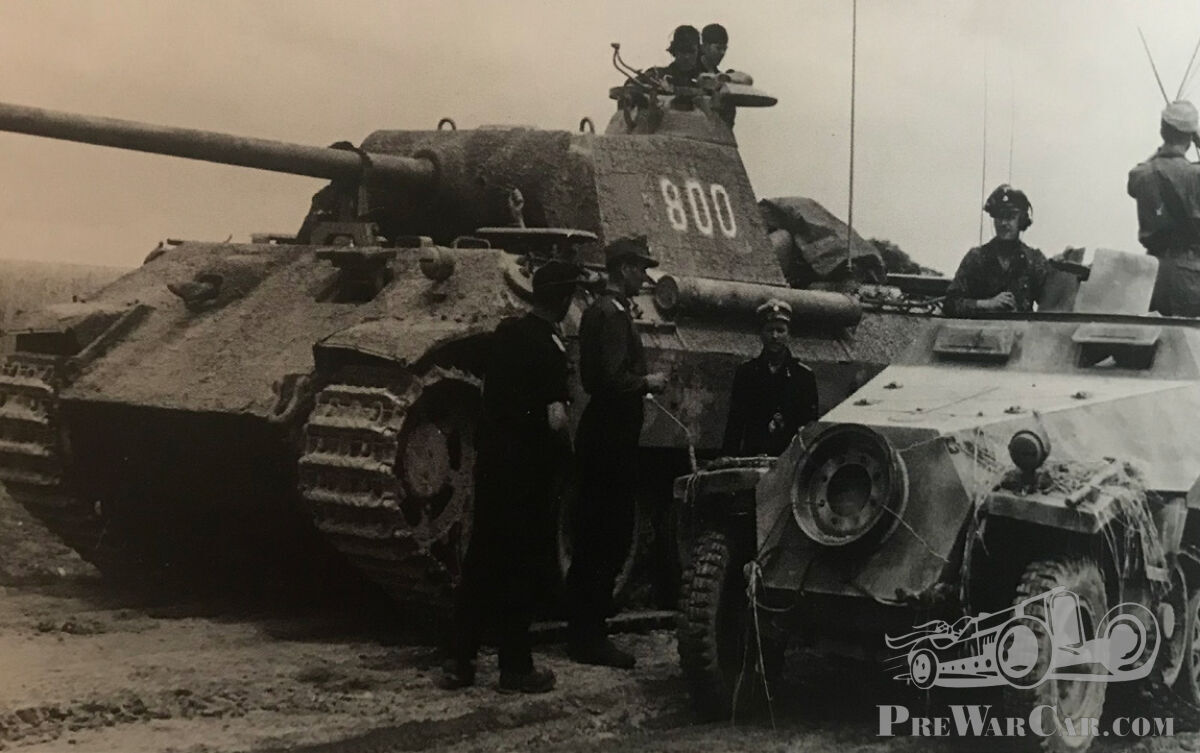
For the 46 edition of Rétromobile, the Musée des Blindés de Saumur presents one of the major pieces of its collection, the German army’s main battle tank: the Panther.
July 1941. It was on the vast Russian expanses that the German armour first came up against the T34 tank divisions of the Red Army. This battle was a surprising and bitter defeat for the Wehrmacht.
In designing the Panther, German engineers drew heavily on the very modern design of the Soviet tank: the armour was tilted to optimise protection without increasing its thickness, and wider tracks were fitted to distribute the weight of the tank more evenly and prevent it from getting stuck in the mud.
The Panther appeared in 1943. Weighing in at 45 tons, this tank was an effective weapon, very mobile, and above all equipped with a very powerful gun that could pierce 10 cm of armour at a distance of 1,500 m. But this warrior had its weaknesses: the development of the Panther did not come without setbacks, and its baptism of fire was tarnished by multiple technical problems. The Panther was penalized by its excessive weight, and its 23-litre Maybach 12-cylinder 700 hp engine which constantly ran at full power would overheat. Its weight led to high fuel consumption: on rough terrain the Panther guzzled 700 litres every 100 kilometres. Nevertheless, the Panther remained a formidable weapon, claiming many Allied armoured vehicles as victims. The construction of the Panther tank required significant material and skilled labour resources. Germany’s industrial resources ran down, meaning that the armaments factories could only supply 5,986 Panther tanks in all versions, compared to 50,000 American Sherman tanks and 60,000 Soviet T34 tanks.
The Panther presented at Rétromobile was part of one of the German armoured divisions that took part in the Battle of Normandy in 1944. Combat was extremely violent, and many German vehicles were destroyed by the Allied forces. The Panther of the Musée des Blindés de Saumur was immobilised by a mechanical breakdown or lack of fuel and its crew rushed to flee without taking the time to sabotage it.
In early 1945, this Panther was recovered with other German machines, to form the French armoured vehicle squadrons composed of tanks captured in battle.
Afterwards, it was stored at Satory before joining the Musée des Blindés de Saumur where it is kept in working order.
Panther Technical Details
- Combat weight: 45 tonnes
- Length: 9 m
- Width: 3.40 m
- Height: 3.10 m
- Crew: 5 men
- Armament: 1 x 75 mm 79-round cannon - 2 x MG 34 4,200-round machine guns
- Armour: from 110 mm to 40 mm
- Engine: 24 litre Maybach 12V, 700 hp.
- Fuel tank: 720 litres
- Consumption: 3 litres per kilometre on-road
- 7 litres per kilometre off-road
- Road speed: 55 km/h
- Total production: 5,986 units
Publiziert:
Mittwoch Februar 16th, 2022
Facebook
LinkedIn
Twitter
WhatsApp
Email
Copy
Kommentare
Richard Smith
18 Februar 2022, 16:05
Nothing to be proud of here. Most probably built by Nazi slave labour.
Weiter lesen