Das weltweite Magazin und der Marktplatz für Oldtimer-Enthusiasten – von Enthusiasten.
Das weltweite Magazin und der Marktplatz für Oldtimer-Enthusiasten – von Enthusiasten.


Filter
Auswahl treffen
- Autos
-
Marke >>
-
Baujahr >>
-
-
Kategorie >>
-
Länder >>
- Motorräder
-
Standort >>
- Teile
-
Automarke >>
-
Hersteller >>
-
Kategorie >>
- Fahrräder
-
Baujahr >>
-
Länder



Racing giants: the Excelsiors of the 1923 Le Mans

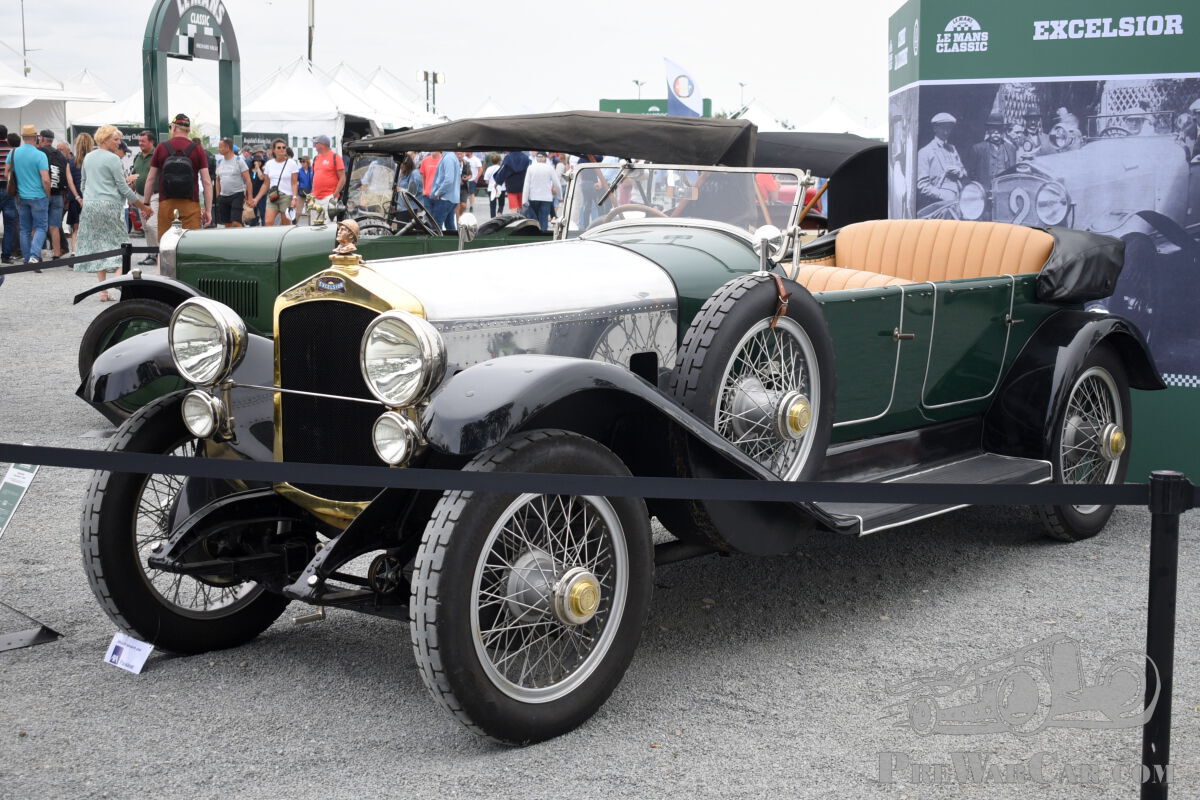


Before 2023 vanishes behind us, we thought we'd take just one more look at the major anniversary of the year, the centenary of the Le Mans 24 Hour Race. In particular we're focussing on the two big Excelsiors which ran in the inaugural 1923 race.
The Excelsior marque is not well-known today, but in its day it was one of Belgium's foremost makers of high-quality luxury cars, alongside Minerva. The post-Kaiser War Type Adex used an overhead-cam version of the 20/30hp engine, which was developed in 1922 into the Excelsior Albert I, the model which ran at Le Mans and which was later described by T. R. Nicholson as 'the most magnificent car the Belgian industry ever produced, comparable with the contemporary H6B Hispano-Suiza'.
The Albert I's impressive size, performance and quality is difficult to exaggerate. With an overhead-cam straight-six of 5,350 cc, it dwarfed the Three-Litre Bentleys and 3.4-litre Lorraine-Dietrichs, and in sports trim it was capable of more than 100 mph, and stopped well with the help of vacuum servo brakes. However, as impressive as all that was, it didn't amount to a winning Le Mans car. If only the two Excelsiors which ran in 1923, carrying the prominent race numbers 1 and 2 because they had the largest engines, had fared better, they might be discussed today with the same familiarity and reverence as Bentley, Chenard et Walcker and Lorraine-Dietrich.
Instead we are left to wonder what happened to these cars at Le Mans. We know that car 2, piloted by the Belgian team of Nicolas Caerels and André Dills, finished a highly respectable joint fourth with the Bentley of John Duff and Frank Clement and the two-litre Bignan 11CV of Philippe de Marne and Jean Martin, having completed 112 laps (1,201 miles) at an average of 50 mph.
Car 1, driven by the Frenchmen Gonzaque Lécureul and M. Flaud, finished ninth, behind a Lorraine-Dietrich and ahead of a Type 22 Bugatti, having completed 106 laps (1,137 miles) at an average of 47.37 mph. Needless to say, they finished first and second in the five-to-eight-litre class, as they were the only cars in it.
That's all very well, but what kept them from the podium? Were the beset by misfortune, or were they simply too large and unwieldy to pose a serious challenge to the smaller cars? If you have the answers, please let us know.
Words: Zack Stiling
The Excelsior marque is not well-known today, but in its day it was one of Belgium's foremost makers of high-quality luxury cars, alongside Minerva. The post-Kaiser War Type Adex used an overhead-cam version of the 20/30hp engine, which was developed in 1922 into the Excelsior Albert I, the model which ran at Le Mans and which was later described by T. R. Nicholson as 'the most magnificent car the Belgian industry ever produced, comparable with the contemporary H6B Hispano-Suiza'.
The Albert I's impressive size, performance and quality is difficult to exaggerate. With an overhead-cam straight-six of 5,350 cc, it dwarfed the Three-Litre Bentleys and 3.4-litre Lorraine-Dietrichs, and in sports trim it was capable of more than 100 mph, and stopped well with the help of vacuum servo brakes. However, as impressive as all that was, it didn't amount to a winning Le Mans car. If only the two Excelsiors which ran in 1923, carrying the prominent race numbers 1 and 2 because they had the largest engines, had fared better, they might be discussed today with the same familiarity and reverence as Bentley, Chenard et Walcker and Lorraine-Dietrich.
Instead we are left to wonder what happened to these cars at Le Mans. We know that car 2, piloted by the Belgian team of Nicolas Caerels and André Dills, finished a highly respectable joint fourth with the Bentley of John Duff and Frank Clement and the two-litre Bignan 11CV of Philippe de Marne and Jean Martin, having completed 112 laps (1,201 miles) at an average of 50 mph.
Car 1, driven by the Frenchmen Gonzaque Lécureul and M. Flaud, finished ninth, behind a Lorraine-Dietrich and ahead of a Type 22 Bugatti, having completed 106 laps (1,137 miles) at an average of 47.37 mph. Needless to say, they finished first and second in the five-to-eight-litre class, as they were the only cars in it.
That's all very well, but what kept them from the podium? Were the beset by misfortune, or were they simply too large and unwieldy to pose a serious challenge to the smaller cars? If you have the answers, please let us know.
Words: Zack Stiling
Publiziert:
Dienstag November 7th, 2023
Facebook
LinkedIn
Twitter
WhatsApp
Email
Copy
Kommentare

Herman van Oldeneel
08 November 2023, 08:06
Driving in the night with very bad weather, poor visibility and lack of proper lights on the Excelsior number 2 caused some troubles for the car. After repairs it raced again. Number 1 finished after 24 hrs with a distance of 1.933,344km (the winner 2.209,536km).
Weiter lesen
John Murch
07 November 2023, 07:58
I believe that one of the Excelsiors spent about two hours being dug out of a sand trap, which will not have helped its chances.
Weiter lesen