Das weltweite Magazin und der Marktplatz für Oldtimer-Enthusiasten – von Enthusiasten.
Das weltweite Magazin und der Marktplatz für Oldtimer-Enthusiasten – von Enthusiasten.


Filter
Auswahl treffen
- Autos
-
Marke >>
-
Kategorie >>
-
Länder >>
- Motorräder
-
Standort >>
- Teile
-
Automarke >>
-
Hersteller >>
-
Kategorie >>
- Fahrräder
-
Baujahr >>
-
Länder



One for the Friday Ladies: the pulling power of a Framo three-wheeler
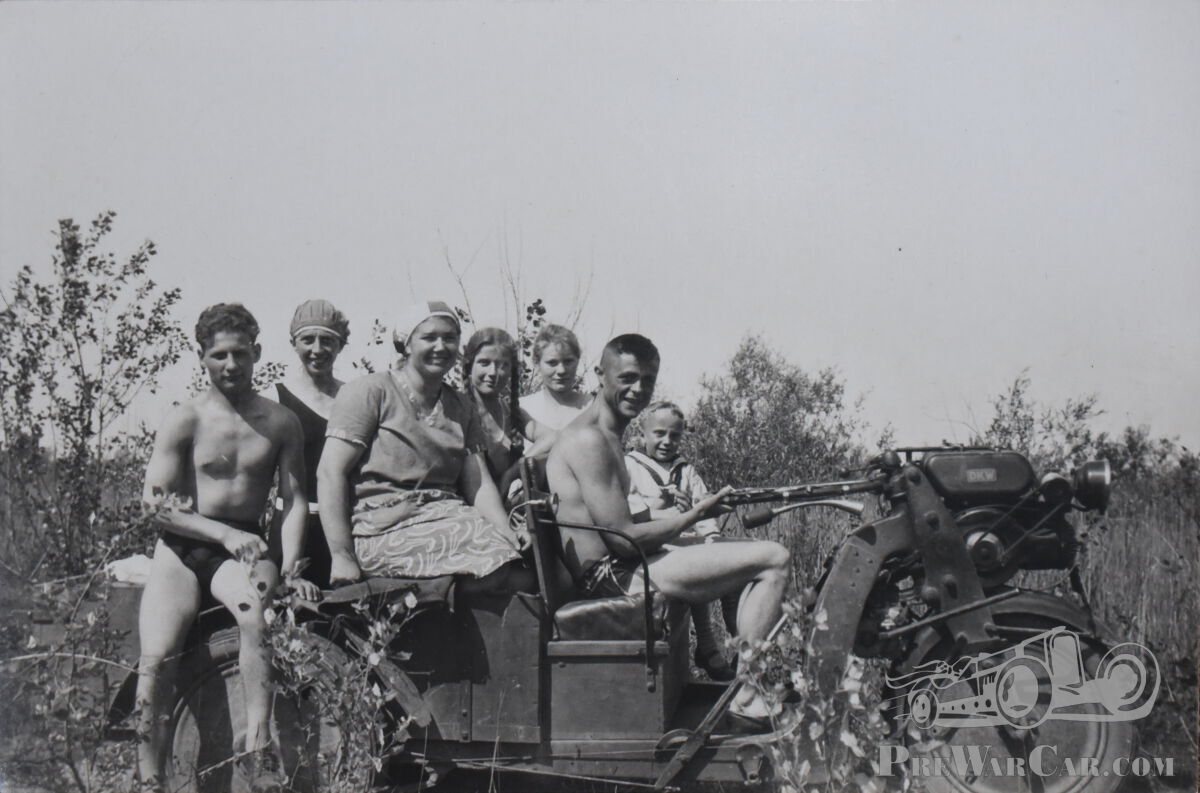

We apologise to our regular readers who await with anticipation our regular Friday Lady photographs, but since we have a number of woman readers, too, it is only right that we consider them from time to time, and we offer this picture for their delectation. For our own part, we're not quite sure where the appeal lies. The decidedly minimalist approach to menswear practised by Adonis One and Adonis Two is, to our eyes, a stylistic disaster, but they nevertheless have been very successful in attracting the fairer sex. "Two girls for every boy," as Jan & Dean sang.
We can only attribute their resounding success to their flash motor. What self-respecting young German maiden wouldn't want to cruise around on the latest speed machine with lightweight bodywork, fashionable disc wheels and advanced front-wheel drive? Where could one buy such a car? We thought at first that it was probably a relation of the Edwardian Phanomobil, but the DKW script on the engine points in a different direction. We are looking, in fact, at a Framo TV300... or LT200, or LT300, &c.
Metallwerke Frankenberg was established in Frankenberg, Saxony, by a Danish engineer, Jørgen Skafte Rasmussen, with Paul Figura in 1923. Rasmussen had already established DKW as a maker of clip-on two-stroke engines in 1919. Marketed as Das Kleine Wunder, DKW soon branched into full-scale motorcycle production and also sold its engines as proprietary units to other manufacturers. It was not until 1928 that it expanded into car production.
The Frankenberg factory was initially established just to produce components for the DKW motorcycles, but it started producing a cargo tricycle in 1927 using a 300cc, single-cylinder, two-stroke DKW engine. These were sold as both the DKW Transportwagen and Framo TV300, the design having originated in the DKW office but Metallwerke Frankenberg taking responsibility for the manufacture. Despite its awkward appearance, the DKW-Framo proved exceedingly popular with tradesmen and, we are told, a thousands of them were sold in the first year or so of production. The model soon spawned a range of derivatives, some with 200cc engines and others with covered plywood cabins and full van bodies. Trying to untangle exactly which was which becomes rather confusing...
Update
We are grateful to DKW historian Mathias Meyer for some corrections and additional information. He advises that the vehicle in the photograph is a TV300, produced from 1927-30, whereas the LT200 and LT300 were produced from 1930-34. The three models could be specified in three forms: as a chassis, a platform truck or a box van.
Words: Zack Stiling
Photograph: Stiling Collection
Publiziert:
Freitag Oktober 18th, 2024
Facebook
LinkedIn
Twitter
WhatsApp
Email
Copy
Kommentare
John Elema
20 Oktober 2024, 13:14
Most probably these people are out on a warm summer's day and, with some of them, in appropriate swimming wear, on their way to a nearby swimming spot.
Weiter lesen