Das weltweite Magazin und der Marktplatz für Oldtimer-Enthusiasten – von Enthusiasten.
Das weltweite Magazin und der Marktplatz für Oldtimer-Enthusiasten – von Enthusiasten.


Filter
Auswahl treffen
- Autos
-
Marke >>
-
Baujahr >>
-
-
Kategorie >>
-
Länder >>
- Motorräder
- Teile
-
Automarke >>
-
Hersteller >>
-
Kategorie >>
- Fahrräder
-
Baujahr >>
-
Länder



"No use trying to sleep, one had to get up and see the fun"
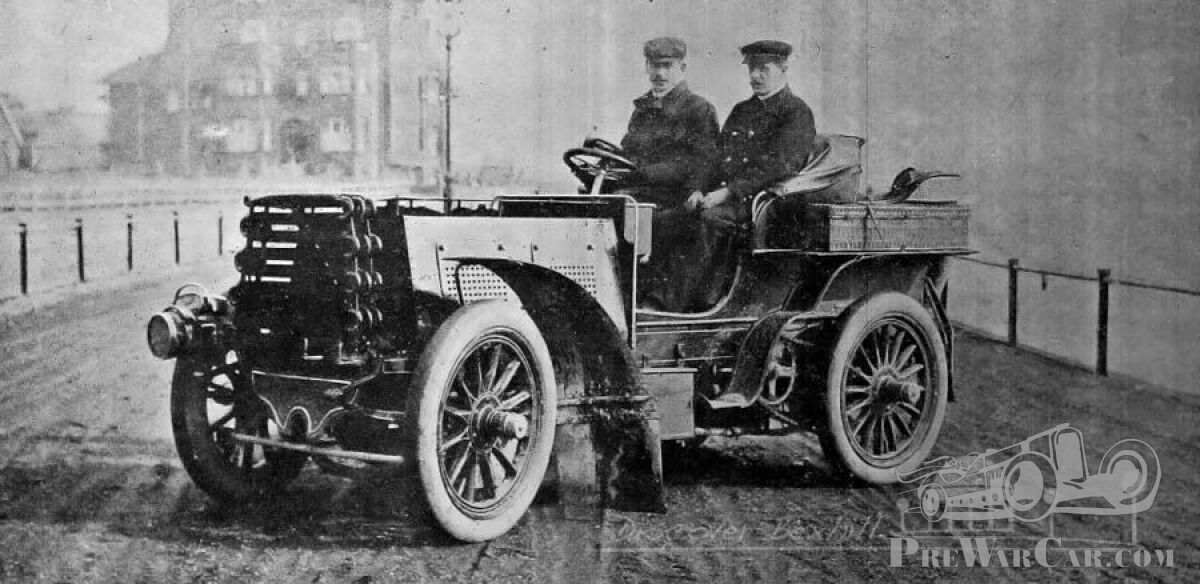
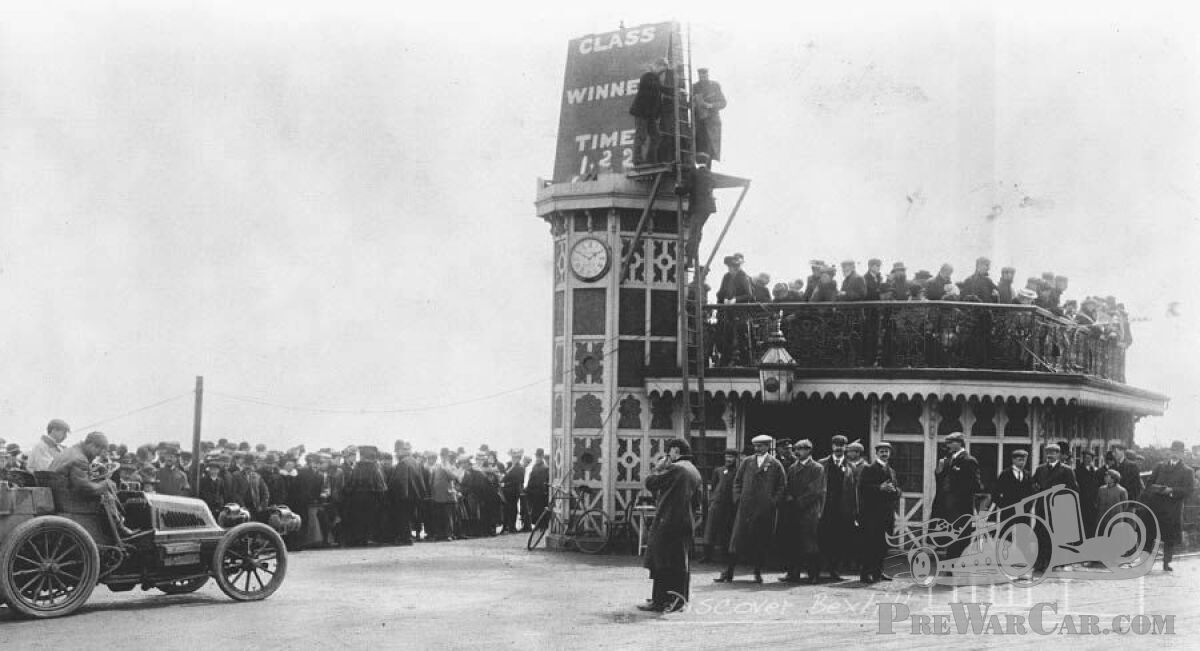
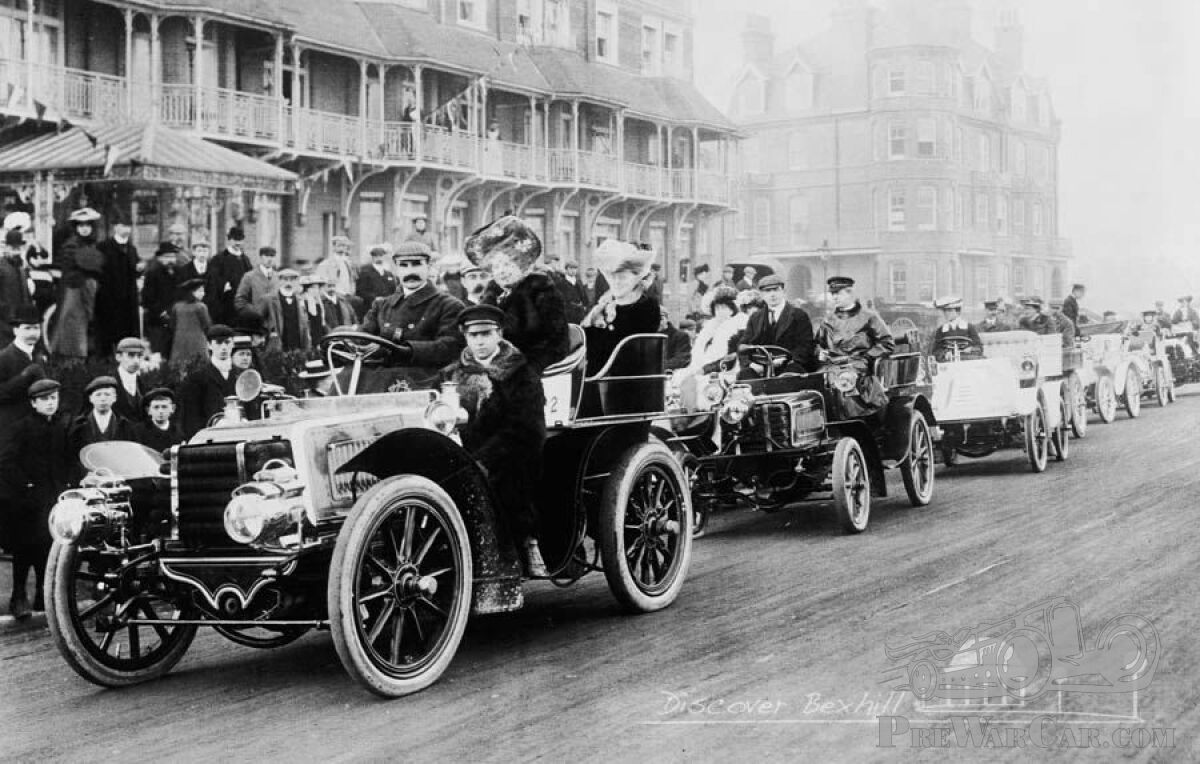
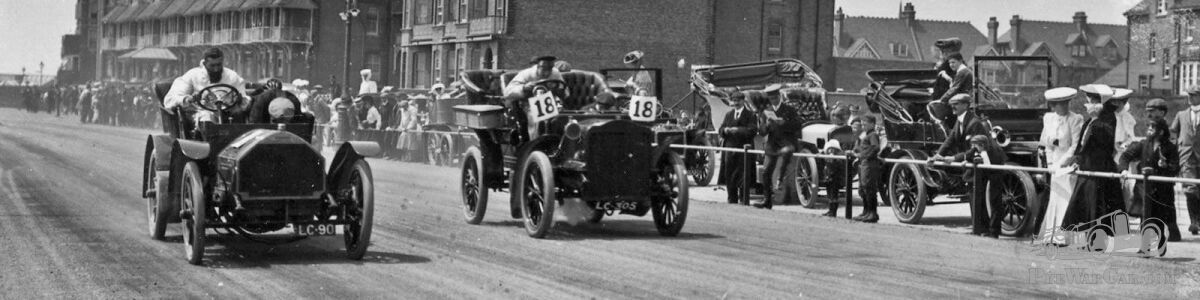


“The very atmosphere reeked with the smell of paraffin. No cabs/horses, only throbbing, puffing & snorting motors everywhere... One had hardly got off to sleep on Sunday night before the clatter and banging of these weird creations had commenced once again. No use trying to sleep, one had to get up and see the fun.” So wrote a spectator at the Bexhill-on-Sea motor race in the Motor Cycling magazine of 21 May 1902.
The birthplace of British motor racing
Cities on the south coast of England have been a popular destination for car enthusiasts since the early days of the automobile. The annual London to Brighton run was and continues to be a popular event. Just to the east of Brighton is Bexhill-on-Sea, also known as 'the birthplace of British motor racing'.
It all goes back to Monday 19 May 1902 when the first International Motor Race Meeting in Great Britain, the Great Whitsuntide Motor Races, was organised. The main person behind the organisation was the 8th Earl De La Warr, a shareholder of Dunlop and resident of Bexhill-on-Sea. He was looking for ways to promote the town and make it an attractive holiday resort to the aristocracy, the rich, the famous and the leaders of industry. His first plan was to turn his private road along the beach into a cycling boulevard, but that was not enough and after a few years the boulevard was opened up to four-wheeled vehicle racing and, together with the Automobile Club of Great Britain (later the RAC), they began to hold car races on the Earl’s private road.
.jpg)
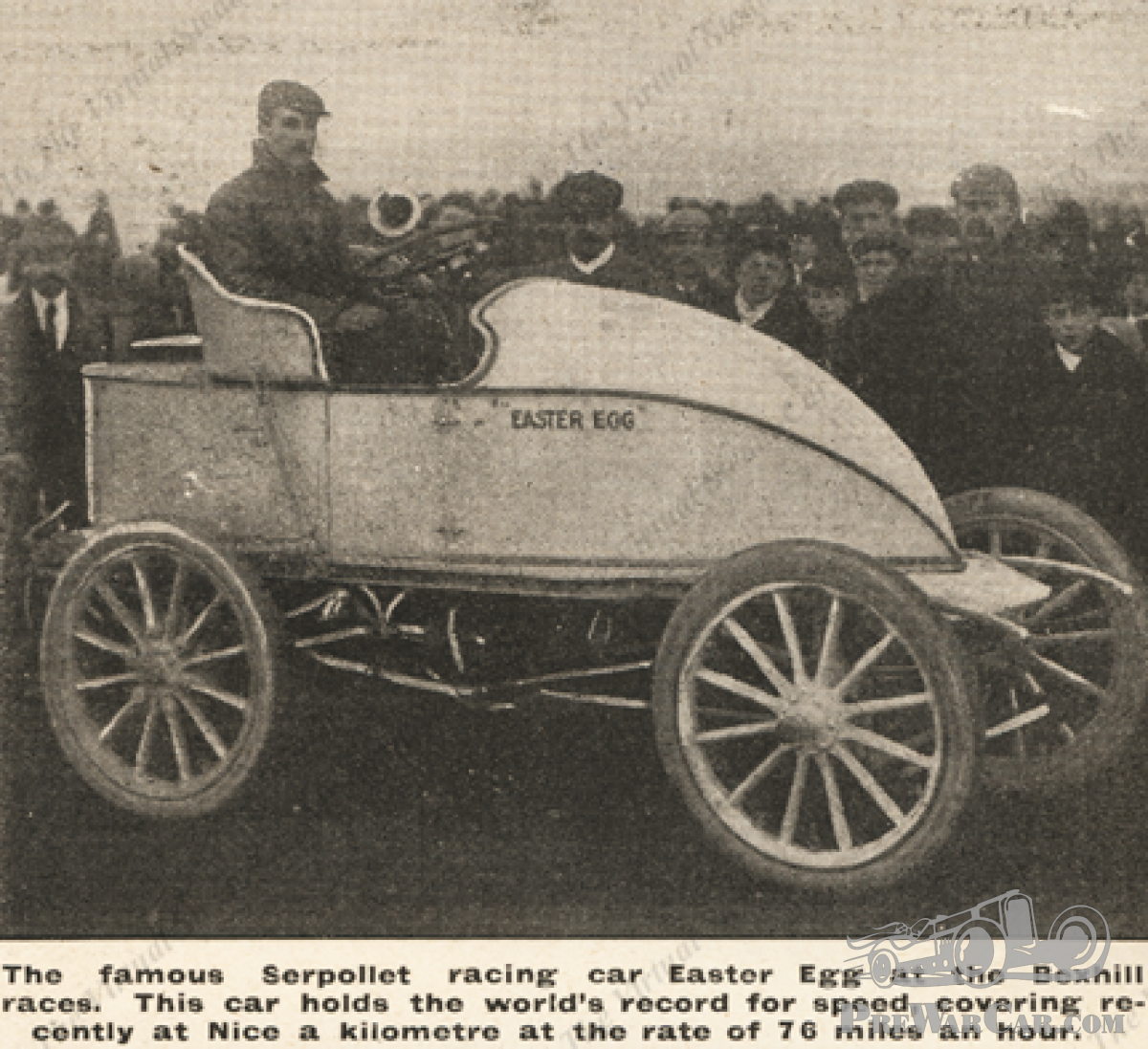
Despite the typical English weather — heavy rain and very windy — it became an immediate success, attracting not only large crowds of spectators (over 30,000) but also many famous names from England and the Continent. Winner of the first event was the Frenchman Léon Serpollet with his 'Easter Egg'. He was already the favourite to win the race, as a few weeks earlier he had set the world record with a speed of 75mph on the beaches of Nice, France. This time he wouldn't come close to that because of the strong winds, but he did set the British land speed record with an impressive 54mph. Another competitor was Lord Northcliffe, founder of the Daily Mail, with his Mercedes. Or how about S.F. Edge with his Napier? One source said that 200 vehicles had registered for the race! Not all went well though as a 24hp Napier went off the cliff and was badly damaged.
Several races followed and plans were made to expand the circuit, but in 1907 another more popular circuit was opened: the now legendary Brooklands. Later races were organised at Bexhill-on-Sea, but they were not as successful as they had been in the early years.
Sources: Virtual Steam Museum, Discover Bexhill and Information signs in Bexhill.
Publiziert:
Mittwoch September 29th, 2021
Facebook
LinkedIn
Twitter
WhatsApp
Email
Copy
Kommentare
David Grimstead
30 September 2021, 17:26
Richard Smith
05 Oktober 2021, 09:01
The LC prefix for London was introduced in 1905.
Weiter lesen
Ariejan Bos
01 Oktober 2021, 10:31
Hi David, thank you for the Bexhill research. The 1905 photo and your comment on this however raises a question, which I cannot answer: according to the Class C racing results as published in The Car Ill. the 2nd place was indeed won by Mr. H. Ramoisy, but The Autocar mentions Capt. Theo. Masui, yes, the English agent for Germain and the man who claimed a few years later to have built the first torpedo body. I cannot deny or confirm that, because information on the races of that year is scarce. In a caption I have of that photo the White was driven by Mr. Coleman, although I cannot confirm that either. You mention a BAC as a participant, which must be a BACS, a short-lived make produced only that year by the British Automobile Commercial Syndicate Ltd., a large London based firm selling many makes like Clement, Clement-Talbot, Panhard & Levassor, Spyker a.o. The BACS had some success at the South Harting hill climb held a few days before this race. By the way, forget about the “e” in Thornycroft.
Weiter lesen
David Grimstead
03 Oktober 2021, 19:25
Ariejan, thanks. Captain Masui was frequently listed as the entrant of Germain cars and some results did name him and/or his drivers. Seemingly, there is no mention of him being the driver in newspaper reports of Bexhill or elsewhere. In July 1905 his 24-H.P. Germain, driven by Ramoisy at Brighton, beat Thornycroft’s Thornycroft and had a dead heat with a Beaufort. Masui’s 24-H.P. Germain was entered in the Scottish reliability trial in May and he had one entered for the I.O.M. T.T. in September. He entered two Germains in the 1906 Frome’s Hill race, a car for H. Ramoisy at the July Aston Hill climb (3rd) and at Blackpool in October he entered two 18-H.P. Germains in the flying kilometre. That driven by Ramoisy won, that by A. Servais was third; some reports say that Masui was “on” the winning car. Ramoisy also did well on a Germain in that year’s Captain Kidd’s hill climb.
During December 1906-January 1907 Masui, his wife, an English mechanic and a servant crossed India from Bombay to Calcutta in a Germain but he was back to enter an 18-H.P. for the Carter’s Hill Cup in June 1907 and “won” a limited engine size/power competition with one at Brooklands in July. Ramoisy won the Class three hill climb at Toys Hill on a Germain in June 1907. In April 1908, Masui entered a 25.6-H.P. Germain in the Brooklands three-mile race for driver G. de Prelle de la Nieppe.
In 1909, as the acclaimed designer of the torpedo body fitted to Germains, etc, he reportedly donated their licensing fees to a motor trade benevolent charity. That year, he entered a 5.9 Gregoire at Brooklands Easter Junior Handicap for driver Max Mahieu, who during WWI appears to have been a member of London-based Belgian military vehicle repair syndicate and who, with George de Prelle de la Nieppe, Guillaume Van den Plas, J. B. Masui and others, was accused of fraud approaching £1M in 1916-19.
Some bosses did drive their company’s cars. In a first heat at Bexhill in 1905, that mere 15-H.P. White of Frederick Coleman beat the 18/24-H.P. B.A.C.S. of Mr. F.F. Wellington, who was then that company’s manager. Although a multiple car agency themselves, a number of garages claimed to be B.A.C.S. agents from 1905 to 1907. B.A.C.S. showed the four-wheel drive Spyker at the 1905 Islington car show but on their stand at the March 1906 show, of eleven cars only one was a B.A.C.S. They supplied the Spykers which won several races at the last Bexhill event in 1907. The B.A.C.S. company was voluntarily liquidated in 1909 by chairman The Earl of Shrewsbury and Talbot to protect the sales of Clement Talbot.
Weiter lesen
During December 1906-January 1907 Masui, his wife, an English mechanic and a servant crossed India from Bombay to Calcutta in a Germain but he was back to enter an 18-H.P. for the Carter’s Hill Cup in June 1907 and “won” a limited engine size/power competition with one at Brooklands in July. Ramoisy won the Class three hill climb at Toys Hill on a Germain in June 1907. In April 1908, Masui entered a 25.6-H.P. Germain in the Brooklands three-mile race for driver G. de Prelle de la Nieppe.
In 1909, as the acclaimed designer of the torpedo body fitted to Germains, etc, he reportedly donated their licensing fees to a motor trade benevolent charity. That year, he entered a 5.9 Gregoire at Brooklands Easter Junior Handicap for driver Max Mahieu, who during WWI appears to have been a member of London-based Belgian military vehicle repair syndicate and who, with George de Prelle de la Nieppe, Guillaume Van den Plas, J. B. Masui and others, was accused of fraud approaching £1M in 1916-19.
Some bosses did drive their company’s cars. In a first heat at Bexhill in 1905, that mere 15-H.P. White of Frederick Coleman beat the 18/24-H.P. B.A.C.S. of Mr. F.F. Wellington, who was then that company’s manager. Although a multiple car agency themselves, a number of garages claimed to be B.A.C.S. agents from 1905 to 1907. B.A.C.S. showed the four-wheel drive Spyker at the 1905 Islington car show but on their stand at the March 1906 show, of eleven cars only one was a B.A.C.S. They supplied the Spykers which won several races at the last Bexhill event in 1907. The B.A.C.S. company was voluntarily liquidated in 1909 by chairman The Earl of Shrewsbury and Talbot to protect the sales of Clement Talbot.
Ariejan Bos
04 Oktober 2021, 17:41
Thanks, David, that is a massive piece of research! No further questions for the moment ...
Weiter lesen
And the two cars are running west to east along Earl De La Warr’s cycle track, when in 1902 they started from the east, Galley Hill end and finished in front of the Sackville hotel at the Cycle Chalet shown in another photo. To defeat an injunction that stopped further racing in 1902, for motor events held from August 1904, the Earl reversed the one kilometre track and pairs of cars started from the Cycle Chalet and finishing on Galley Hill.
This photo is from the Third, June 1905, Bexhill Motor Meeting as the car on the right is a 1904/5 15-H.P. White Steamer, three of which appeared that year racing against at least a B.A.C., another White, a Thorneycroft and a 24-H.P. Germain, which is the car on the left and which won this heat in Class 3 for £350-650 chassis for the Earl De La Warr’s cup. It lost in the final to the 28-H.P. Daimler of A. H. Bush (55.6 secs) but driver H. Ramoisy (78.6 secs) took home an Automobile Club of GB Silver Medal. The White, depending which heat this shows, was driven by T. Shaw or F. Coleman.
Notable also, that despite dire predictions before the 1902 Bexhill event, contemporary reports say there were no car accidents. The only injuries were to a dog run over in front of the Sackville Hotel and a bleeding horse, injured as it shied from the noisy cars. Nor were there any when the annual reliability run went there in 1903, at the 1904 event, at 1905’s, at the 1906 hill climb or at the last event in May 1907.
However, in 1907 a 24-H.P. Napier belonging to Mr John Lion did go over the cliff near Galley Hill. The car was being test driven by local motor repair engineer Mr. H. Pulham with the owner’s chauffeur, Mr. W, J. Warren, his passenger. The crash occurred on a test drive up the track to Galley Hill on Saturday, 17th September 1907 when a spring broke as the brakes were applied nearing the top and an overfilled petrol tank set the engine alight. Pulham tried to engage neutral but got reverse, causing the car to bounce backwards over the rough ground fortunately expelling both men uninjured before going over the 50 foot cliff edge and onto the beach, exploding there and burning out completely, all £800-worth of it!
The 1902 Bexhill race event was responsible for another first: encouraging “wanna-be” street racers. As Captain Noble, the Chairman of Uckfield Petty Session Bench, said as he fined twenty drivers £10 plus costs each for speeding at between 20 and 36 M.P.H. leaving Bexhill: “I am afraid motors are getting into the hands of cads and 'Arries, who imagine the roads belong to them.”