Das weltweite Magazin und der Marktplatz für Oldtimer-Enthusiasten – von Enthusiasten.
Das weltweite Magazin und der Marktplatz für Oldtimer-Enthusiasten – von Enthusiasten.


Filter
Auswahl treffen
- Autos
-
Marke >>
-
Baujahr >>
-
-
Kategorie >>
-
Länder >>
- Motorräder
- Teile
-
Automarke >>
-
Hersteller >>
-
Kategorie >>
- Fahrräder
-
Baujahr >>
-
Länder



Mysterious Lincoln in Germany on New Year’s Day
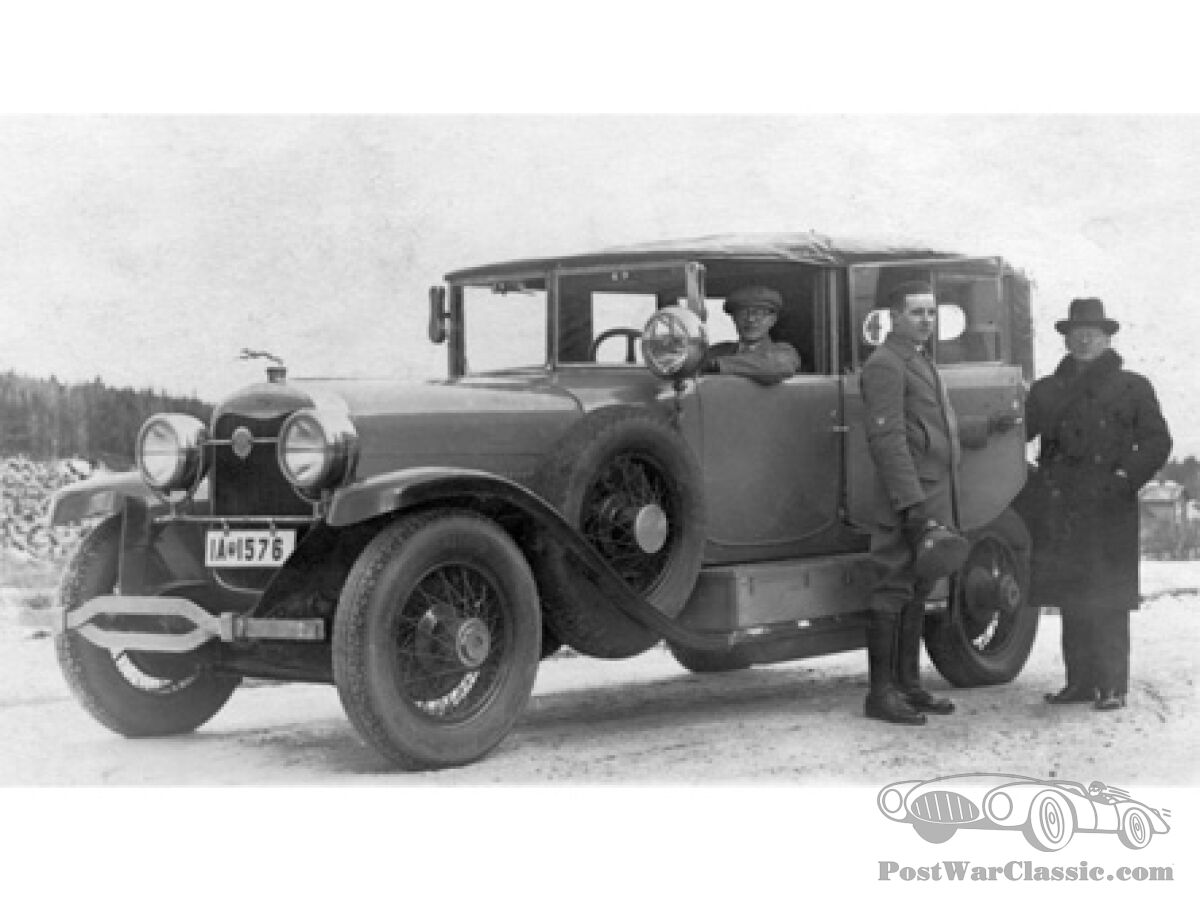

Almost exactly 90 years ago – in winter 1927/28 – a gentleman from Berlin spent some vacation time in the “Riesengebirge” – a mountain area in the German province of Silesia (today a part of Poland). On the occasion of New Year’s Day he sent a postcard showing him and his impressive car to a friend in the tiny village of Neustadt (Thuringia). I acquired the postcard recently having only a vague idea of the kind of automobile in the picture.
I was pretty sure that it was a US car from the mid/late 1920s – even if the manufacturers' name on the radiator badge seemed illegible in the beginning. In particular, the chunky front bumper made me initially believe it was just another of the many mass-produced American vehicles that had a huge market share in Germany back then. Well - to cut a long story short - a certain resemblance of the radiator with that of Ford’s Model A (of all cars!) made me research in a different direction which eventually resulted in a match: Lincoln – a brand forming part of the Ford conglomerate since 1922.
Suddenly, the badge on the radiator with hardly a few legible letters made perfect sense, as did the awkward-looking front bumper, the distinctly shaped hubcaps, and – most importantly – the greyhound mascot that became standard equipment on Lincolns starting in 1925.
The drum-shaped front lights – clearly outdated at that time, in my opinion – indicated a date of manufacture between 1924 and 1926, at least according to the Standard Catalogue of American Cars from 1805 until 1942 (by B.R.KIimes/H.A.Clark).
I was almost about to close this case as solved, as I noticed a detail which challenged my hypothesis – the brake drums at the front axle! They were introduced on publicly available Lincolns only in 1927, but then you would also have expected bowl-shaped front lights.
Of course, one might assume that Lincolns destined for overseas markets would have differed from cars for the domestic market in several ways. Perhaps the newly developed front lights of the 1927 Lincoln didn’t comply with some odd regulations in Europe, so Lincoln continued to mount the traditional ones on cars to be exported.
But: the story does not end here. Probably the most remarkable feature of the Lincoln with registration in the district of Berlin (“IA”) is the vertically split front window – which I was unable to find in any other picture showing a contemporary Lincoln.
What’s more, the entire body behind the engine compartment is hardly what you would expect on a luxury car. To me, this body – obviously of the sedan-convertible type – shows some similarities with crew carriers used by fire brigades or the police at that time. What also strikes me as odd is the fact that the running board is completely “occupied” by a large box – containing hunting gear, perhaps. How was the owner supposed to enter the car on this side without having to climb on the box first – a humiliating experience, wouldn’t you think?
Now it’s your turn, dear fellow enthusiasts. Can anyone shed some light on the identity and origin of this supposed 1927 Lincoln? Has a car with similar features appeared yet?
Many thanks in advance for any insights and let me use this opportunity to wish all of you a “Gutes Neues Jahr” from Germany!
Words and photographs by Michael Schlenger.
Publiziert:
Montag Januar 15th, 2018
Facebook
LinkedIn
Twitter
WhatsApp
Email
Copy
Kommentare
jaap ter linden
17 Januar 2018, 23:21
Michael Schlenger
17 Januar 2018, 14:01
Dear Peter,
Thanks for your assessment (and, of course, many thanks for all the other valuable comments - including the one referring to a certain character in "Allo, Allo!"...).
Is there a specific detail apart from the shape of the doors that makes the identification as a body by Saoutchik probable?
Actually, I find it hard to believe that a businessman from Berlin ordered such a rather sober-looking body for his Lincoln in Paris rather than relying on the countless manufacturers in the German capital.
Can we rule out the possibility that this body was simply inspired by a certain style created by contemporary French designers such as Saoutchik?
While Saoutchik did build bodies for Lincolns in the 1920s (see http://www.coachbuild.com/forum/viewtopic.php?f=55&t=3343), I don't see a particularly striking resemblance.
If this car really turned out to be a Saoutchik creation, however, I'd be delighted, no doubt about that!
Weiter lesen
Thanks for your assessment (and, of course, many thanks for all the other valuable comments - including the one referring to a certain character in "Allo, Allo!"...).
Is there a specific detail apart from the shape of the doors that makes the identification as a body by Saoutchik probable?
Actually, I find it hard to believe that a businessman from Berlin ordered such a rather sober-looking body for his Lincoln in Paris rather than relying on the countless manufacturers in the German capital.
Can we rule out the possibility that this body was simply inspired by a certain style created by contemporary French designers such as Saoutchik?
While Saoutchik did build bodies for Lincolns in the 1920s (see http://www.coachbuild.com/forum/viewtopic.php?f=55&t=3343), I don't see a particularly striking resemblance.
If this car really turned out to be a Saoutchik creation, however, I'd be delighted, no doubt about that!
Peter Larsen
17 Januar 2018, 10:54
I have studied the image closely, and I am 99% sure it is a Saoutchik transformable
Best
Peter Larsen
Author Jacques Saoutchik Maitre Carrossier
Weiter lesen
Best
Peter Larsen
Author Jacques Saoutchik Maitre Carrossier
Graham Allum
16 Januar 2018, 12:11
Interesting picture & Very interesting vehicle. The Greyhound was available from 25. Lincoln went to full crown guards for 1925 but the guards on this car are not those available in the USA. Also the headlight fitment is not as per Lincoln and drum lights were still available in 26 but bullet shaped lights with dual filament globes were introduced for 1927. Front brakes were fitted to Police vehicles from 1924, so a chassis going overseas could quite easily have 4 wheel brakes fitted. Judkins also used a similar treatment. So to sum up I feel that a 25/26 Lincoln Chassis/Radiator, bonnet & Cowl were sent to Europe were a body such as Francisco suggests was fitted.I will alert my Finnish friend who seems to know every pre-war Lincoln in Europe!!!
Weiter lesen
jaap ter linden
16 Januar 2018, 07:26
I agree, it must be a Saoutchichik body.
Weiter lesen
phil cordery
15 Januar 2018, 17:03
Curved bottoms to Doors are reminiscent of French bodied cars, the front brakes on the Model L, were initially only fitted to Police cars & Known as Lincoln Fliers, brakes were then removed before selling car on to the public, The headlamps look like standard Bausch & Lomb but the spot is a French Grebel
Weiter lesen
Daniel Reuben
15 Januar 2018, 12:50
The body looks like a Sedanca de Ville. This is supported by the break in roof fabric behind driver, the line on inside roof suggesting a division and the large locker box on running board to stow roof material. The passenger should be getting in on the curb side! There are trafficators on the windshield, not usually seen in US versions at this time. The two men commanding the car appear to have uniforms with a small medallion or insignia. I wonder if this matches the badge on front crossbar (added to car).
Weiter lesen
Ace Zenek
15 Januar 2018, 11:27
George Dammann and James Wagner state the following in their book The Cars of Lincoln Mercury. "The [pointed] headlights were a running change, and most Salon models used the old style shells that were installed early in the year until the new units could be installed."
Weiter lesen
Francisco Carrión Cá
15 Januar 2018, 09:21
Very interesting... this is a Saoutchik body!
Weiter lesen
Peter Ransom
15 Januar 2018, 06:41
I agree that it appears to be a 1927 chassis with earlier headlights. And as you say, it's possible that export chassis were built to a different specification, especially as the better makes of British and European cars had standardized on 4wb well ahead of the Americans. The body, however, looks to me like an "all-weather" or convertible sedan, but hardly a crew-carrier. Who knows what mysteries lie in the box on the running board? But the owner wouldn't ordinarily be entering the car on the driver's side. The front bumpers and drum headlights are not at all unusual on American cars of the period. The shock absorbers look like Houdaille hydraulics and the turn indicators are fascinating. It's possible the very slim window frames provide a clue as to the coachbuilder: this style was originated by Georges Gangloff and was dubbed "Clear Vision". Walter M. Murphy copied it in the USA and it appeared on a number of his bodies and series of Murphy-designed Hudson.
And a Happy New Year from Australia!
Weiter lesen
And a Happy New Year from Australia!
Do you agree that is is a Lincoln with Lincoln mudguards and typical Lincoln bumpers, but with a Saoutchik body, probably from a somewhat older car ?
(your books are really fantastic !)