Das weltweite Magazin und der Marktplatz für Oldtimer-Enthusiasten – von Enthusiasten.
Das weltweite Magazin und der Marktplatz für Oldtimer-Enthusiasten – von Enthusiasten.


Filter
Auswahl treffen
- Autos
-
Marke >>
-
Baujahr >>
-
-
Kategorie >>
-
Länder >>
- Motorräder
-
Standort >>
- Teile
-
Automarke >>
-
Hersteller >>
-
Kategorie >>
- Fahrräder
-
Baujahr >>
-
Länder



Monday mystery: a Scottish runabout of unknown origin
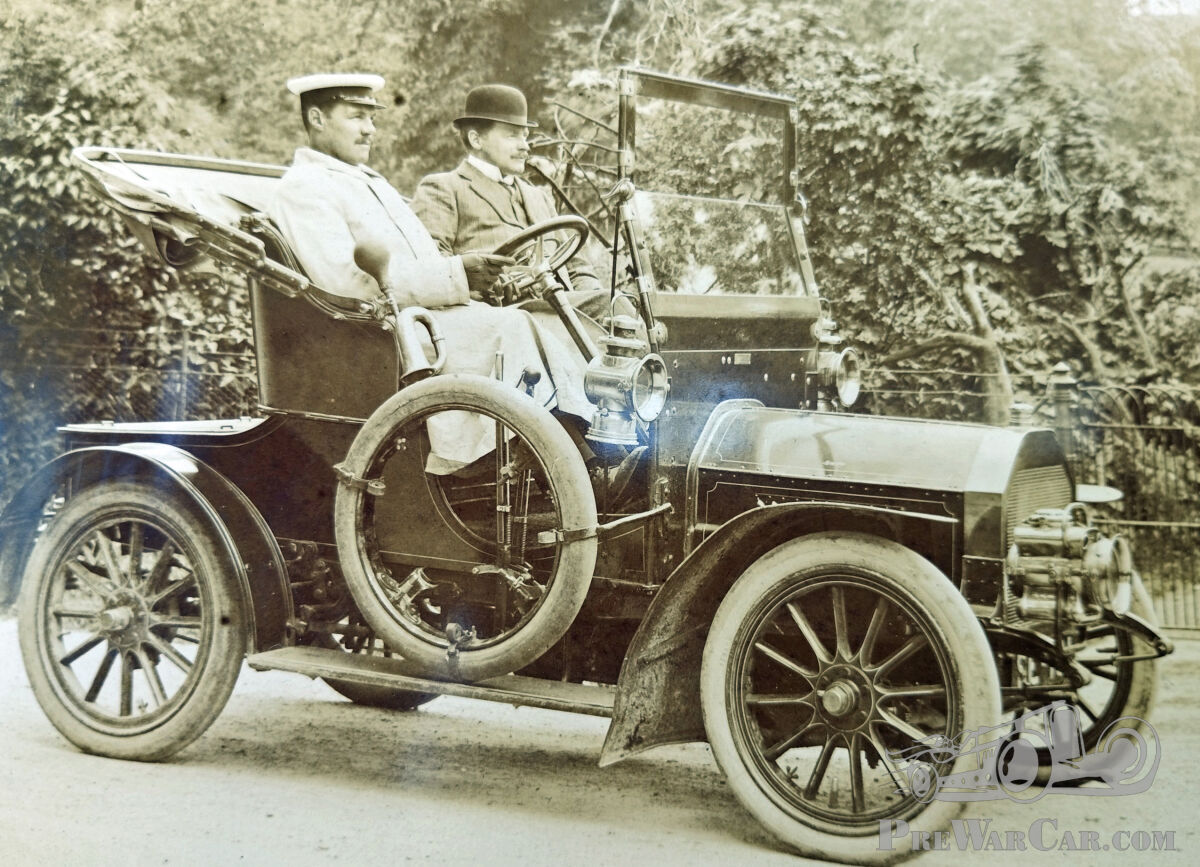

Today's puzzle comes from Thomas Int-Veen of Hanover, who has been some shopping far from home. The photograph we're looking at was bought from a bookshop in Edinburgh, and, logically enough, he asks if it might show a Scottish-built car such as an Argyll or an Albion. We're sorry to disappoint, but we think not. If we suppose that this car dates from about 1906, give or take a year or two, we can see that it has neither the shapely radiator of an Argyll of the period, nor the blunt, squarish radiator of the Albion. However, one make we won't rule out is Arrol-Johnston. Arrol-Johnston seems to have used a number of different designs before settling on a coal-scuttle bonnet and rear-mounted radiator after the Renault fashion later in the Edwardian age, so we wonder, could it be an Arrol? Then again, there would have been a number of much shorter-lived and lesser-known car-makers still active in Scotland at the time, so it could well be something else entirely. It would not be at all surprising if it actually turns out to be the product of an English manufacturer, but we are inclined to doubt that it's a European one.
All we are really able to confirm is that the car was registered in Scotland, as the SE code places it within Banffshire, a county in the north-east bordered to the north by the Moray Firth and to the south and east by Aberdeenshire. Beyond that, we can only remark that we are a little surprised by the driving arrangements. Considering it's not an especially big car and it carries an informal style of bodywork, we would have expected its owner to also be its driver, but he appears to have confined himself to the passenger seat so that the chauffeur can do the hard work.
Maybe the owner didn't like driving, but still it seems the level of familiarity between servant and master seems unusual for the time. If he could afford to keep a chauffeur, he could surely have afforded to spend a bit extra on a touring-bodied car, and so avoided having to fraternise so closely with one of the lower orders. Then again, if the master was of a kindly disposition and his servant hard-working and loyal, there's no reason why they shouldn't have assumed an equal footing for the sake of a pleasure outing, especially if both were keen motorists, and they do look reasonably pleased to be out on the road.
That's about all we've picked up on, though. Certainly there is nothing about the car which give away its identity to us. Once again, it's over to you to give us a hand...
Words: Zack Stiling
Photograph: Thomas Int-Veen
Publiziert:
Montag Juni 24th, 2024
Facebook
LinkedIn
Twitter
WhatsApp
Email
Copy
Kommentare
Alexander Stolpmann
02 Juli 2024, 03:20
Thomas Int-Veen
15 Juli 2024, 16:56
Thanks a lot for the detailed comment, and sorry for the loss in the Euro final yesterday. At least it wasn't the German team.
Thomas
Weiter lesen
Thomas
Martin Hunter
24 Juni 2024, 20:46
Certainly a Banffshire registration. Possibly a low number so 1904 or '05.
Weiter lesen
Ariejan Bos
24 Juni 2024, 12:58
The radiator may look slightly more edgy than you would expect, but in every other detail this car fits the 1907 or 1908 two-cylinder Swift. This car was a regular winner in the Scottish Trials, so clearly well-suited for the area!
Weiter lesen
The car in the above picture seems to have a short wheelbase and could therefore be a 9/10hp with two-cylinder, 1,400 c.c. Swift engine and 6ft. 10½in. wheelbase, or a 9/11hp with three-cylinder, 1,357 c.c. White & Poppe engine, 6ft. 10½in. wheelbase. Larger engines were, to my knowledge, available for longer wheelbases only.