Das weltweite Magazin und der Marktplatz für Oldtimer-Enthusiasten – von Enthusiasten.
Das weltweite Magazin und der Marktplatz für Oldtimer-Enthusiasten – von Enthusiasten.


Filter
Auswahl treffen
- Autos
-
Marke >>
-
Baujahr >>
-
-
Kategorie >>
-
Länder >>
- Motorräder
- Teile
-
Automarke >>
-
Hersteller >>
-
Kategorie >>
- Fahrräder
-
Baujahr >>
-
Länder



The White House’s mighty White
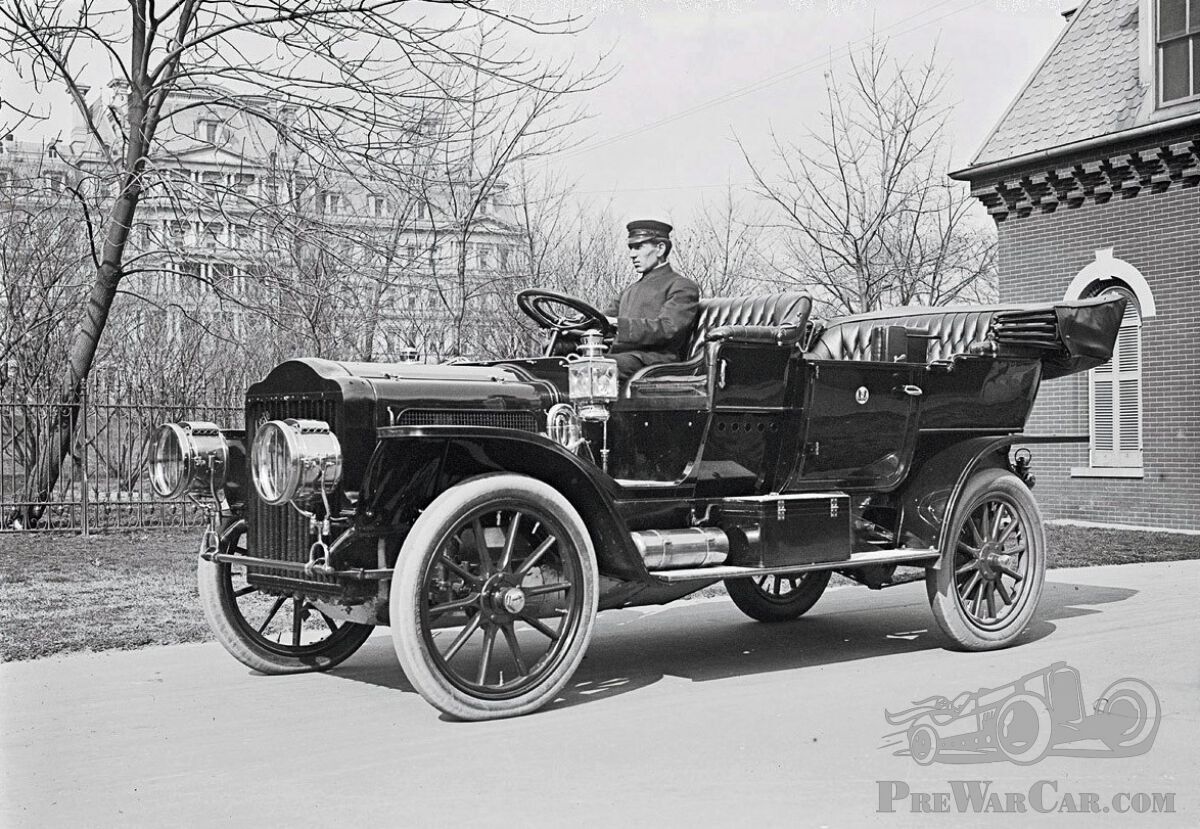

We came across this image of this impressive motorcar as ‘President Roosevelt’s White steam car’. Now, it is possible that Roosevelt drove — or was driven rather — in this mighty steamer, but we found out soon enough that he apparently was no motor enthusiast when we discovered that it was his successor president Taft who ordered the car's purchase. This when he was the President-elect in 1909.
Taft reportedly knew his motors, as mentioned in a report at the time: "The President-elect has had three years' experience in White steamers, and his choice is naturally pleasing to the makers of the White. A gasoline town car also has been purchased for the use of Mrs. Taft." But the people from Washington weren’t too sure about Taft’s passion for engineering, it seems. Another report mentions: “In 1909, onlookers shouted 'Get a horse!' when President William Howard Taft rode out of the White House grounds in a 'steam snorter'. It was the first official presidential automobile.”
Yet another article mentioned: "The garage will be in charge of George Robinson, who has been detailed from his duties in the War Department to drive the presidential White steamer, the car purchased by Mr. Taft for his personal use." And we guess it must be Mr. Robinson who’s seen here behind that big wheel. The colour of the car was "a harmonious blend of subdued greens", with the United States coat-of-arms painted on each of the doors.
For us enthusiasts, it’s good to learn that the car survives in the Heritage Museum and Gardens in Sandwich, Massachusetts, in a display known as ‘The Celebration of the American Automobile’.
Words Jeroen Booij. Picture Grundy Insurances.
Publiziert:
Mittwoch April 6th, 2022
Facebook
LinkedIn
Twitter
WhatsApp
Email
Copy
Kommentare
Mike Williams
08 April 2022, 10:21
I am aware that there was more than one car manufacturer named White. However, a small number of White commercial chassis reached the UK. Do the factory records survive showing the numbers built and the identification of customers?
Weiter lesen
David Grimstead
11 April 2022, 00:06
Mike, if you mean in Roosevelt/Taft’s time: White steam car chassis were exported from Cleveland to The White Company of London with its showroom and assembly factory at 35-37, Regent-street/Kingly-street, which had them fitted with car or commercial bodies by Cann Ltd. 6-h.p. cars were on sale by 1902 and two delivery vans on car chassis were displayed with four 10-h.p. cars at the January 1903 Crystal Palace Motor Show; one van was shown again in 1904 and the car chassis with a more powerful engine was usefully lengthened for 1905. Later some complete 15-h.p. cars with American-made bodies were sold.
In 1908, to handle increasing sales, they built a large, functionally advanced, four-storey vehicle assembly factory at Carlow-street/Miller-street, Camden Town and had regional offices in Albion-street, Gaythorn, Manchester and 6-7 Devon Place, Edinburgh. By 1911 they had advertised commercials that included convertible car-vans, vans up to 1500lb/30cwt and trucks or lorries of 1-ton, 1.5-ton and 3-ton capacity, using standard 10, 15, 18, 20, 30 or 40-h.p. car engines. From 1909 petrol engined versions must have been available since chassis were interchangeable.
Larger White steam commercial users included Messrs. Liberty of Regent-street, London who ran “a string” of vans from 1904 to at least 1910. A parcel delivery van added in 1906 was based on the same model of 15-h.p.chassis that Frederick Abernethy Coleman, White’s British and European manager, had entered in the 1905 IOM TT – not for nothing was Coleman regarded by some as the finest car salesman of his era!
A. W. Gamage Ltd., the sports equipment firm in London, also operated seven, probably one-ton, steam vans based on 20-h.p. chassis between at least 1908 and 1910 when each logged about 12000 miles per year, getting up to 15 miles to a gallon of paraffin and potentially over 200 miles from a tank of water. Having White’s assembly and repair facility in London may well have encouraged their loyalty...
At least one 1.5-ton flat-bed White steam lorry was constructed by Cann’s in 1908 for export to a mining company in Sumatra.
As examples of lesser companies, in 1915 The Aerated Water Company of Hythe sold on their 30cwt lorry, as did Goodhew of Sittingbourne, their 30-h.p. fruit lorry sold with large body and detachable tilt. Stubbs in Manchester sold on a “35-h.p., 25cwt war-pattern White steam lorry with Lynot resilient wheels” in 1916 – there must be many more examples.
White Company sales ledgers opened to reporters in 1910 showed dozens of satisfied car customers had made repeat purchases, often advertising and selling their old vehicles after a few years. Other businesses advertised to buy old car chassis to convert to vans or lorries; a seller in Scotland had offered one “in splendid condition, with spares, £75” for that purpose in 1911. White chassis, with steam generators that could burn petrol, “benzine” or lower taxed paraffin, were probably popular during WWI. National second hand sales adverts show that older White Steamer commercials were still in use widely in Britain up to the mid-1920s.
Weiter lesen
In 1908, to handle increasing sales, they built a large, functionally advanced, four-storey vehicle assembly factory at Carlow-street/Miller-street, Camden Town and had regional offices in Albion-street, Gaythorn, Manchester and 6-7 Devon Place, Edinburgh. By 1911 they had advertised commercials that included convertible car-vans, vans up to 1500lb/30cwt and trucks or lorries of 1-ton, 1.5-ton and 3-ton capacity, using standard 10, 15, 18, 20, 30 or 40-h.p. car engines. From 1909 petrol engined versions must have been available since chassis were interchangeable.
Larger White steam commercial users included Messrs. Liberty of Regent-street, London who ran “a string” of vans from 1904 to at least 1910. A parcel delivery van added in 1906 was based on the same model of 15-h.p.chassis that Frederick Abernethy Coleman, White’s British and European manager, had entered in the 1905 IOM TT – not for nothing was Coleman regarded by some as the finest car salesman of his era!
A. W. Gamage Ltd., the sports equipment firm in London, also operated seven, probably one-ton, steam vans based on 20-h.p. chassis between at least 1908 and 1910 when each logged about 12000 miles per year, getting up to 15 miles to a gallon of paraffin and potentially over 200 miles from a tank of water. Having White’s assembly and repair facility in London may well have encouraged their loyalty...
At least one 1.5-ton flat-bed White steam lorry was constructed by Cann’s in 1908 for export to a mining company in Sumatra.
As examples of lesser companies, in 1915 The Aerated Water Company of Hythe sold on their 30cwt lorry, as did Goodhew of Sittingbourne, their 30-h.p. fruit lorry sold with large body and detachable tilt. Stubbs in Manchester sold on a “35-h.p., 25cwt war-pattern White steam lorry with Lynot resilient wheels” in 1916 – there must be many more examples.
White Company sales ledgers opened to reporters in 1910 showed dozens of satisfied car customers had made repeat purchases, often advertising and selling their old vehicles after a few years. Other businesses advertised to buy old car chassis to convert to vans or lorries; a seller in Scotland had offered one “in splendid condition, with spares, £75” for that purpose in 1911. White chassis, with steam generators that could burn petrol, “benzine” or lower taxed paraffin, were probably popular during WWI. National second hand sales adverts show that older White Steamer commercials were still in use widely in Britain up to the mid-1920s.
David Grimstead
06 April 2022, 16:58
In 1909, Taft reportedly ordered two White Model M Tourers to be used for state occasions as official White House cars, although use of two government 30-h.p. White steam cars had already begun during Roosevelt’s presidency when they clearly impressed Taft who was photographed and reported in one in September 1907:
“Two White steam-cars form the Government passenger transport service between Oyster Bay railway-station and Sagamore Hill, where President Roosevelt spends part of the summer months. When Mr. Secretary Taft, the War Minister, recently visited America’s great man, he described the White steam car as “a regular Government star route-conveyance” and wished Sagamore Hill had been farther away from the station. Then the President suggested that he could travel back all the way to Long Island City in the White, and this he did; but so keen was he on the travel of the car that he continued over the Ferry, across New York, and over the second Ferry to Pennsylvania Station at Jersey City.” Also, the cars “meet every train and, in addition, perform countless other missions for the Secret Service men and other officials at the ‘Summer Capital’.“
There are photos of the President Elect and his family, with a chauffeur, out in one or other of the Whites in January 1909 – it does not have a government coat of arms on the doors and Taft’s cars appear to have slightly different rear body and lighting details to the one shown here.
Newspapers reported that Taft’s other official cars in 1909 were Pierce-Arrows. The first was a 6-cylinder 48-h.p. suburban, ordered in February 1909 and used by his family to attend the inauguration ceremony and subsequently by him. It had an extra open touring body made for it for summer use and it was kept in readiness 15 hours per day (Taft was said to sleep only six hours per night). A second smaller P-A ordered from Buffalo in April/May 1909 was a 36-h.p. landaulet, which like the first was paid for with money appropriated by Congress. Both these cars were dark blue with a russet side stripe; the enclosed first had blue broadcloth upholstery and the open second, grey whipcord. Both had the Government coat-of-arms emblazoned on each door panel, as does the White shown here.
Hence, perhaps with a full head of steam up or maybe gas-pedal to the metal, President Taft was observed in May 1909 exceeding the 20mph speed limit on the new boulevard between Baltimore and Washington, “which indicated that some pressing affair of state required his immediate attention several miles up the road." And he broke the law knowing that his wife had been at some risk from such lawlessness when driving herself in her own small car; presumably why he had already ordered yet another gas-engined one for her to be driven in instead...
For, in April 1909, Mrs. Taft had demonstrated that she was an accomplished driver when she “escaped by a hairsbreadth” a collision with a larger touring car in Washington by a deft flick of the tiller of her “electric runabout motorcar”; presumably one similar to those in your recent post about recharging Baker Electric runabouts.
Weiter lesen
“Two White steam-cars form the Government passenger transport service between Oyster Bay railway-station and Sagamore Hill, where President Roosevelt spends part of the summer months. When Mr. Secretary Taft, the War Minister, recently visited America’s great man, he described the White steam car as “a regular Government star route-conveyance” and wished Sagamore Hill had been farther away from the station. Then the President suggested that he could travel back all the way to Long Island City in the White, and this he did; but so keen was he on the travel of the car that he continued over the Ferry, across New York, and over the second Ferry to Pennsylvania Station at Jersey City.” Also, the cars “meet every train and, in addition, perform countless other missions for the Secret Service men and other officials at the ‘Summer Capital’.“
There are photos of the President Elect and his family, with a chauffeur, out in one or other of the Whites in January 1909 – it does not have a government coat of arms on the doors and Taft’s cars appear to have slightly different rear body and lighting details to the one shown here.
Newspapers reported that Taft’s other official cars in 1909 were Pierce-Arrows. The first was a 6-cylinder 48-h.p. suburban, ordered in February 1909 and used by his family to attend the inauguration ceremony and subsequently by him. It had an extra open touring body made for it for summer use and it was kept in readiness 15 hours per day (Taft was said to sleep only six hours per night). A second smaller P-A ordered from Buffalo in April/May 1909 was a 36-h.p. landaulet, which like the first was paid for with money appropriated by Congress. Both these cars were dark blue with a russet side stripe; the enclosed first had blue broadcloth upholstery and the open second, grey whipcord. Both had the Government coat-of-arms emblazoned on each door panel, as does the White shown here.
Hence, perhaps with a full head of steam up or maybe gas-pedal to the metal, President Taft was observed in May 1909 exceeding the 20mph speed limit on the new boulevard between Baltimore and Washington, “which indicated that some pressing affair of state required his immediate attention several miles up the road." And he broke the law knowing that his wife had been at some risk from such lawlessness when driving herself in her own small car; presumably why he had already ordered yet another gas-engined one for her to be driven in instead...
For, in April 1909, Mrs. Taft had demonstrated that she was an accomplished driver when she “escaped by a hairsbreadth” a collision with a larger touring car in Washington by a deft flick of the tiller of her “electric runabout motorcar”; presumably one similar to those in your recent post about recharging Baker Electric runabouts.
John Bates
06 April 2022, 11:50
It's interesting that 'The garage will be in charge of George Robinson' rather than George being in charge of the garage. Not much of a manager then?
Weiter lesen