Das weltweite Magazin und der Marktplatz für Oldtimer-Enthusiasten – von Enthusiasten.
Das weltweite Magazin und der Marktplatz für Oldtimer-Enthusiasten – von Enthusiasten.


Filter
Auswahl treffen
- Autos
-
Marke >>
-
Baujahr >>
-
-
Kategorie >>
-
Länder >>
- Motorräder
-
Standort >>
- Teile
-
Automarke >>
-
Hersteller >>
-
Kategorie >>
- Fahrräder
-
Baujahr >>
-
Länder



Kings of the Road: three jewels from a grand American motor house
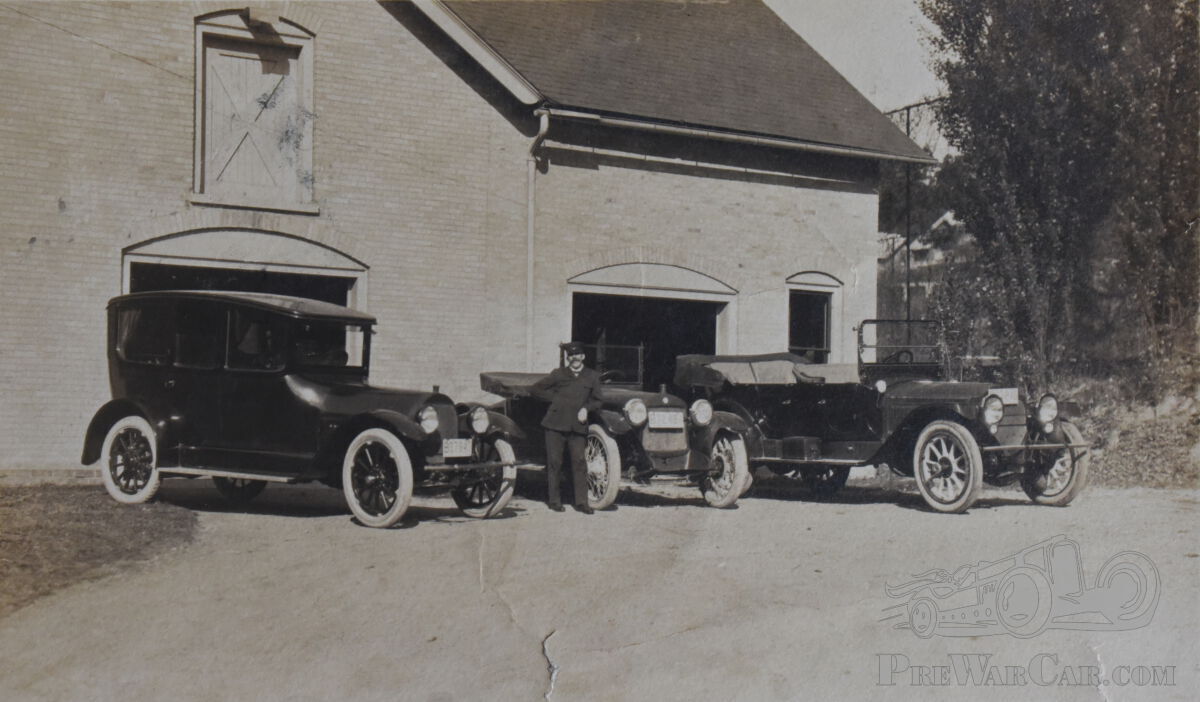

We know that car ownership was a source of pride during the Brass Era, but to have three cars, and two of them distinctly high-end ones at that, was certainly an enviable situation. The custodian of this handsome trio was by no means unaware of his good fortune. He sent the photograph, which must date from circa 1916/17, to a friend, writing on the back, "Dear Hardy: Here is the Kissel, the Hup, the Packard, the garage, and who is the man, do you suppose?"
We can't answer the question of the man, but we could assume that he is the sender. He also has the apperance of a chauffeur. If we are right on both counts, one can sense the pride with which he wrote his little note. "Here I am, the son of a groom, now in charge of three of America's finest motor cars," he must have been thinking.
The Hupmobile in the centre, perhaps, was not quite as grand as the others, but it still represented a fine steed for a young man new to the affluent and glamorous world of motoring. The other two really represented the cream of American motor engineering. Kissel of Hartford, Wisconsin, would become best -known for its rakish Gold Bug speedster of the Gatsby era, but it had been making cars since 1906 and from 1909 started making large six-cylinder models. It even offered, for a brief period, a V12. These were never intended as sports cars, just as powerful and luxurious touring cars to rival the likes of Packard and Pierce-Arrow.
Speaking of Packard, that had more success with the 12-cylinder formula. The famous Twin-Six entered the market in 1916 as the world's first 12-cylinder car to go into sustained series production, as well as being the first American touring car to use aluminium pistons. An enlarged racing version would be driven to 150mph by Ralph de Palma at Daytona in 1919. Reasonably priced at $2,900, the Twin-Six became Packard's only offering from 1916 to 1920, and so we think it very likely that it is a Twin-Six we see here on the right.
What a life our lucky chauffeur must have led. Who wouldn't want to swap places with him just for a day?
Words: Zack Stiling
Photograph: Stiling Collection
Publiziert:
Dienstag November 26th, 2024
Facebook
LinkedIn
Twitter
WhatsApp
Email
Copy
Kommentare
Edwin Hayslip
26 November 2024, 15:50
A number of car makes offered a centre-entrance sedan in the teens. Although I've never seen one, I believe Chevrolet had a driver's door on the driver's side and a centre door on the passenger side. Seems like a good idea. Ford offered a centre-door sedan through mid-1923. Fords had an oval rear window which seems to be unique on this sedan.
Weiter lesen