Das weltweite Magazin und der Marktplatz für Oldtimer-Enthusiasten – von Enthusiasten.
Das weltweite Magazin und der Marktplatz für Oldtimer-Enthusiasten – von Enthusiasten.


Filter
Auswahl treffen
- Autos
-
Marke >>
-
Baujahr >>
-
-
Kategorie >>
-
Länder >>
- Motorräder
- Teile
-
Automarke >>
-
Hersteller >>
-
Kategorie >>
- Fahrräder
-
Baujahr >>
-
Länder



How many Clyno cars exactly came to Australia during the 1920s?


We received the following message:
“I am an Australian motoring journalist writing an article about a 1926 Clyno (the car in the picture (click to enlarge)) that came to our shores during the 1920s. In researching for information for the article I am trying to find out how many came to Australia. I understand that the Rootes Organization was the UK exporting agent.
I understand that Clyno was a family company, originally a motorcycle manufacturer stating in 1909, then shifting to car production in 1922. Taking on the might of British manufacturers Austin and Morris at their own game, in an attempt to build a better-quality value-for-money car for the masses, and with 12,000 built-in 1926 alone, they were to become the third largest car manufacturer in England during the ‘Roaring Twenties’. However, the family company was underfinanced and by the time the effects of the ‘Great Depression’ hit in 1929, they were insolvent and the end was nigh.
In seven short years of production, they achieved a great deal, with some 50,000 cars produced, including exports to several countries, ours being one. It is not known just how many arrived on our shores, but 47 did in chassis and associated running gear guise (the result of our federal government’s import restrictions on fully built up vehicles in order to protect the local motor body building industry) came to Sydney with the bodies built in Alexandria by Steenbhoms Motor Bodies. I also know that 58 were shipped to Adelaide, where Holdens Motor Body builders fitted the bodies. I have no doubt more were shipped to other Australian ports where the local motor body builders would fit the bodies.”
As you can read Jim has amassed a deal of information about the company. Now he is particularly interested to find out how many Clyno cars exactly came to Australia during the 1920s. And if any of them are still around. Jim already managed to track down three other ones plus “half a car of parts (chassis etc)” as he told us. Besides this, he is also attempting to find out the motor body builders who contracted to build the bodies. About this, he wrote to us“ you see our government back then had a strict tariff on importing motor vehicles that were complete – in order to protect our motor body builders – you could only import the chassis with its running gear ready to accept a body.”
Very knowledgeable readers and friends. Is there anyone who can help Jim further in his research? Any information on the above marque would be of great assistance. Please comment below.
We look forward to reading the final article about this beautiful 1926 Clyno Jim!
Words by the editor. Photograph sent in by Jim Gibson.
Publiziert:
Montag Januar 11th, 2021
Facebook
LinkedIn
Twitter
WhatsApp
Email
Copy
Kommentare
Greg Bishop
09 März 2021, 12:57
Christopher mawbey
11 Januar 2021, 08:05
I'm reading all this as my 81 year old father was just telling me about a CLINO ute he travelled to coonabarabran with his father to collect in the 1950s.
He remembers it as being quite gutless on petrol, stalling I many a hill and needing a push.
So his dad converted it to power kerosene making it quite usable and powerful enough to carry a load up the same hill it wouldn't go over without a load.
He beleive it is still on the former family property at Westella.
Weiter lesen
He remembers it as being quite gutless on petrol, stalling I many a hill and needing a push.
So his dad converted it to power kerosene making it quite usable and powerful enough to carry a load up the same hill it wouldn't go over without a load.
He beleive it is still on the former family property at Westella.
noel sherry
02 Oktober 2020, 13:31
Hello
I own a fully working 1927 fabric body Clyno saloon which visited Australia for a short period when the then owners emigrated there . They subsequently returned to England with their Clyno .
I am advised that the vehicle I own was displayed , new , on the Clyno stand at the 1927 motor show at Olympia , London , England . The vehicle currently resides at my London address .
This may be of interest to you .
Regards
Noel
Weiter lesen
I own a fully working 1927 fabric body Clyno saloon which visited Australia for a short period when the then owners emigrated there . They subsequently returned to England with their Clyno .
I am advised that the vehicle I own was displayed , new , on the Clyno stand at the 1927 motor show at Olympia , London , England . The vehicle currently resides at my London address .
This may be of interest to you .
Regards
Noel
John Watson
20 Juli 2020, 16:07
I have a 1926 (or 1927) 10.8 hp Clyno originally purchased new by my Grandfather in Queensland for my Aunt. It has passed down to me for my 21st birthday in 1953. I have the original papers, handbook and hire-purchase papers.
Body by Steencombs, sold by Canada Motor and Cycle Works, Brisbane.
Originally a 4-door tourer, but following a rear-end collision with a stationary tree, the rear body tub etc. was removed and replaced by a wooden utility body. In later years I removed this, and re-built the rear end as a 2-seater roadster, following many illustrations and diagrams of such a body as was originally obtainable.
It is in full running order, being on a Club "Concessional" Licence.
I have many spares, collected over the years, including radiator, cylinder heads, dynamo, etc.
Her name (bestowed by my Aunt in 1927) is "Priscilla".
Weiter lesen
Body by Steencombs, sold by Canada Motor and Cycle Works, Brisbane.
Originally a 4-door tourer, but following a rear-end collision with a stationary tree, the rear body tub etc. was removed and replaced by a wooden utility body. In later years I removed this, and re-built the rear end as a 2-seater roadster, following many illustrations and diagrams of such a body as was originally obtainable.
It is in full running order, being on a Club "Concessional" Licence.
I have many spares, collected over the years, including radiator, cylinder heads, dynamo, etc.
Her name (bestowed by my Aunt in 1927) is "Priscilla".
John Ryder
08 März 2020, 08:22
......Many years ago I discovered the remains of a CLINO out past COBAR , I asked the owner ' how did it go .??.' he said " No GOOD as it kept falling over ..!!..".. so I pressed him for more info and he went on, " they were top heavy and no good for Australian conditions, and did tip over on there side quiet easly ...."...... I didn't bother to load it and bring it home, looked a bit like a Morris in the mid '20's.......John Ryder......
Weiter lesen
Stephen Ashton
22 Juli 2020, 18:03
Earlier export models had issues with the bad road conditions in Australia at the time and to compensate the export "colonial model" axle width was increased by 6 inches over the UK domestic models. A belt driven fan was also fitted to supplement the standard thermo -siphoning system.
Weiter lesen
David Anderson
06 März 2020, 07:46
Gentlemen,
Speaking of Clyno, I have the remains of 3 Clyno motorcycles and have struggled to find information or parts in Australia. Is there a register here or a parent club in the UK? I have seen 2 restored Clyno motorcycles in NZ and have heard about 2 others in Australia but not seen them. Any information would be gratefully received.
Regards
David Anderson (Melbourne) email: [email protected]
Weiter lesen
Speaking of Clyno, I have the remains of 3 Clyno motorcycles and have struggled to find information or parts in Australia. Is there a register here or a parent club in the UK? I have seen 2 restored Clyno motorcycles in NZ and have heard about 2 others in Australia but not seen them. Any information would be gratefully received.
Regards
David Anderson (Melbourne) email: [email protected]
Jim Gibson
19 Januar 2020, 04:17
Hi Arthur,
Mate, I would dearly love to take you up on your offer, about giving me the information you have about Clyno cars in Australia.
My email is gibbos@southernphone .com.au
Could you please make contact with me.
Thanking you and kind regards,
Jim
Weiter lesen
Mate, I would dearly love to take you up on your offer, about giving me the information you have about Clyno cars in Australia.
My email is gibbos@southernphone .com.au
Could you please make contact with me.
Thanking you and kind regards,
Jim
Chris Telford
14 Januar 2020, 11:26
Jim
I have only just become aware of your search. I live in central Victoria and would be very interested in any information you would care to share I have 3 Cyno’s that I have collected over the last 15 years . The first was possibly a tourer that has been cut down to a Ute the second was a part complete project that the fellow was intending to finish as a roadster. The last was a royal saloon that must have been imported, because I believe that Australian coach builders didn’t make a saloon. With all the cars came spare parts so I have 5 engines with the mounts and numbers on the mounts. By the way I haven’t started restoring any of the cars, but the saloon is in very good condition and very complete. Please contact me if I can help with information am willing to share anything I know.
Weiter lesen
I have only just become aware of your search. I live in central Victoria and would be very interested in any information you would care to share I have 3 Cyno’s that I have collected over the last 15 years . The first was possibly a tourer that has been cut down to a Ute the second was a part complete project that the fellow was intending to finish as a roadster. The last was a royal saloon that must have been imported, because I believe that Australian coach builders didn’t make a saloon. With all the cars came spare parts so I have 5 engines with the mounts and numbers on the mounts. By the way I haven’t started restoring any of the cars, but the saloon is in very good condition and very complete. Please contact me if I can help with information am willing to share anything I know.
paul adams
26 September 2019, 21:11
Hello Clyno Owner...
I live in UK....I recently acquired a 1928 Clyno "Royal" open tourer..................Only 3 owners in 90+ years.
The previous owner ( Frank Walker( my old Pal, bought the car for £70 (UK0 in 1964.
Frank and I did untold miles over the years.....Frank died in 2018.....I bought the car at Auction.(for old time sake)
I use the car almost every week!!
The car came with a spare 12HP Engine, 2 spare wheels and 31 Rally event tropghies.
The orinal sales receipt (£70) came with the extensive history file, which Frank put togethet.......Regards Paul
Weiter lesen
I live in UK....I recently acquired a 1928 Clyno "Royal" open tourer..................Only 3 owners in 90+ years.
The previous owner ( Frank Walker( my old Pal, bought the car for £70 (UK0 in 1964.
Frank and I did untold miles over the years.....Frank died in 2018.....I bought the car at Auction.(for old time sake)
I use the car almost every week!!
The car came with a spare 12HP Engine, 2 spare wheels and 31 Rally event tropghies.
The orinal sales receipt (£70) came with the extensive history file, which Frank put togethet.......Regards Paul
John Morrissey
23 September 2019, 13:36
Hi Jim,
Doing some reading, in the Old Motor and Vintage Commercial magazine dated May 1965, there is a story on the Clyno by D.B.W? Where he discusses that one 22hp Clyno 8 prototype had passed its experimental phase. RH Colliers took possession of it in the wind up of the company, used it as a delivery vehicle and it was later delivered to Mr Hartman of Wolverhampton by a Mr Sautt who had previously worked in the Clyno repair shop.
Regards
John
Weiter lesen
Doing some reading, in the Old Motor and Vintage Commercial magazine dated May 1965, there is a story on the Clyno by D.B.W? Where he discusses that one 22hp Clyno 8 prototype had passed its experimental phase. RH Colliers took possession of it in the wind up of the company, used it as a delivery vehicle and it was later delivered to Mr Hartman of Wolverhampton by a Mr Sautt who had previously worked in the Clyno repair shop.
Regards
John
Graeme Simpson
30 Juli 2019, 02:57
In 1975 there were 4 Clyno cars shown in the membership list of the Vintage Drivers' Club in Victoria, 2 tourers and 2 roadsters. I'd prefer not to publish the owners' names, but could give them to Jim should he make contact.
Weiter lesen
Jim Gibson
30 Juli 2019, 23:27
Greg,
Thank you for your comment and taking an interest in my research. If you have a photo of your car I would be interested in seeing it.
Many thanks & kind regards,
Jim
Weiter lesen
Thank you for your comment and taking an interest in my research. If you have a photo of your car I would be interested in seeing it.
Many thanks & kind regards,
Jim
Jim Gibson
30 Juli 2019, 23:24
Graeme,
I would be very grateful to received the information that you have about Clyno owners in Victoria.
Many thanks & kind regards,
Jim
Weiter lesen
I would be very grateful to received the information that you have about Clyno owners in Victoria.
Many thanks & kind regards,
Jim
Greg Hill
29 Juli 2019, 22:32
Hi Jim,
I live in Queensland and purchased a Clyno in 1972. Not sure of the model or year but it has 4 wheel brakes and much the same as the car you have pictured. There are no mudguards and appears to have been turned into a utility but runs and drives nicely and has a spare engine in very poor condition. I still have it tucked away as a future project.
Regards, Greg Hill
Weiter lesen
I live in Queensland and purchased a Clyno in 1972. Not sure of the model or year but it has 4 wheel brakes and much the same as the car you have pictured. There are no mudguards and appears to have been turned into a utility but runs and drives nicely and has a spare engine in very poor condition. I still have it tucked away as a future project.
Regards, Greg Hill
Greg Smith
29 Juli 2019, 15:08
The registration details of all Victorian Clynos are with a friend in Melbourne , you can contact me at [email protected], Cheers Greg Smith
Weiter lesen
Arthur McNamara
29 Juli 2019, 12:19
Hi Jim,
I live in Sydney Australia, during the early 1970s , I owned a 1926 Clyno on which I commenced a full restoration. At that time I conducted extensive research into Clyno cars including technical matters and the geographical aspects of Clyno Cars in Australia. I corresponded with owners in Australia and New Zealand and started an informal register of (then) known cars and owners in both countries. I still have a quantity of my research matter which you may wish to view. Arthur
Weiter lesen
I live in Sydney Australia, during the early 1970s , I owned a 1926 Clyno on which I commenced a full restoration. At that time I conducted extensive research into Clyno cars including technical matters and the geographical aspects of Clyno Cars in Australia. I corresponded with owners in Australia and New Zealand and started an informal register of (then) known cars and owners in both countries. I still have a quantity of my research matter which you may wish to view. Arthur
Jim Gibson
19 November 2019, 21:21
Hi Arthur,
I would be extremely grateful if you could send me the information that you have, and also do you know just how many Clynos came to Australia?
Which is the best way for you to send me the information that you offered me. Electronically or by mail? If it is by mail I would gladly pay the postage.
My address in Australia is – 67 Edward Ave Kings Point NSW 2539.
Please advise me of your thoughts.
Thanking you in anticipation.
Kind regards,
Jim
Weiter lesen
I would be extremely grateful if you could send me the information that you have, and also do you know just how many Clynos came to Australia?
Which is the best way for you to send me the information that you offered me. Electronically or by mail? If it is by mail I would gladly pay the postage.
My address in Australia is – 67 Edward Ave Kings Point NSW 2539.
Please advise me of your thoughts.
Thanking you in anticipation.
Kind regards,
Jim
Jim Gibson
29 Juli 2019, 22:50
Hi Arthur,
Mate, I would be very grateful if I could view the Clyno details you have, as it would, I have no doubt, help me in my research.
My email address is: [email protected]
Many thanks for your offer.
Cheers,
Jim
Weiter lesen
Mate, I would be very grateful if I could view the Clyno details you have, as it would, I have no doubt, help me in my research.
My email address is: [email protected]
Many thanks for your offer.
Cheers,
Jim
Jim Gibson
06 August 2019, 06:12
Hi Arthur,
You suggested that I may wish to view the Clyno information that you have. Yes I would love to, so could you please advise me as to how I would be able to do so please?
Many thanks,
Jim
Weiter lesen
You suggested that I may wish to view the Clyno information that you have. Yes I would love to, so could you please advise me as to how I would be able to do so please?
Many thanks,
Jim
Jim Gibson
18 August 2019, 23:51
Hi Arthur,
Which is the best way for you to send me the information that you offered me. Electronically or by mail? If it is by mail I would gladly pay the postage.
My address in Australia is – 67 Edward Ave Kings Point NSW 2539.
Please advise me of your thoughts.
Thanking you in anticipation.
Kind regards,
Jim
Weiter lesen
Which is the best way for you to send me the information that you offered me. Electronically or by mail? If it is by mail I would gladly pay the postage.
My address in Australia is – 67 Edward Ave Kings Point NSW 2539.
Please advise me of your thoughts.
Thanking you in anticipation.
Kind regards,
Jim
Jim Gibson
09 September 2019, 23:15
Hi Arthur,
Which is the best way for you to send me the information that you offered me. Electronically or by mail? If it is by mail I would gladly pay the postage.
My address in Australia is – 67 Edward Ave Kings Point NSW 2539.
Please advise me of your thoughts.
Thanking you in anticipation.
Kind regards,
Jim
tony taylor
29 Juli 2019, 11:31
tony taylor ,,, regards my reply with photo MY email is [email protected] thank you tony
Weiter lesen
Daryl Meek
29 Juli 2019, 10:18
Jim,
Dr Peter McMahon from Victoria restored a Clyno in the 60s or 70s. The vehicle was sold sometime to a new owner, with the vehicle staying in Australia. I am only aware of the vehicle through Peter (now deceased) as I purchased his 1913 Fafnir quite a number of years ago.
I am still in contact with the family and would be happy to make further enquiries if interested.
I can be contacted at [email protected]
Regards, Daryl Meek
Weiter lesen
Dr Peter McMahon from Victoria restored a Clyno in the 60s or 70s. The vehicle was sold sometime to a new owner, with the vehicle staying in Australia. I am only aware of the vehicle through Peter (now deceased) as I purchased his 1913 Fafnir quite a number of years ago.
I am still in contact with the family and would be happy to make further enquiries if interested.
I can be contacted at [email protected]
Regards, Daryl Meek
Jim Gibson
01 August 2019, 05:34
Hi Daryl,
Thanks for you comment on my Clyno request for information. Yes please , if you would be kind enough to ask the family if they have a contact for the person who purchased the car.
Kind regards,
Jim
Weiter lesen
Thanks for you comment on my Clyno request for information. Yes please , if you would be kind enough to ask the family if they have a contact for the person who purchased the car.
Kind regards,
Jim
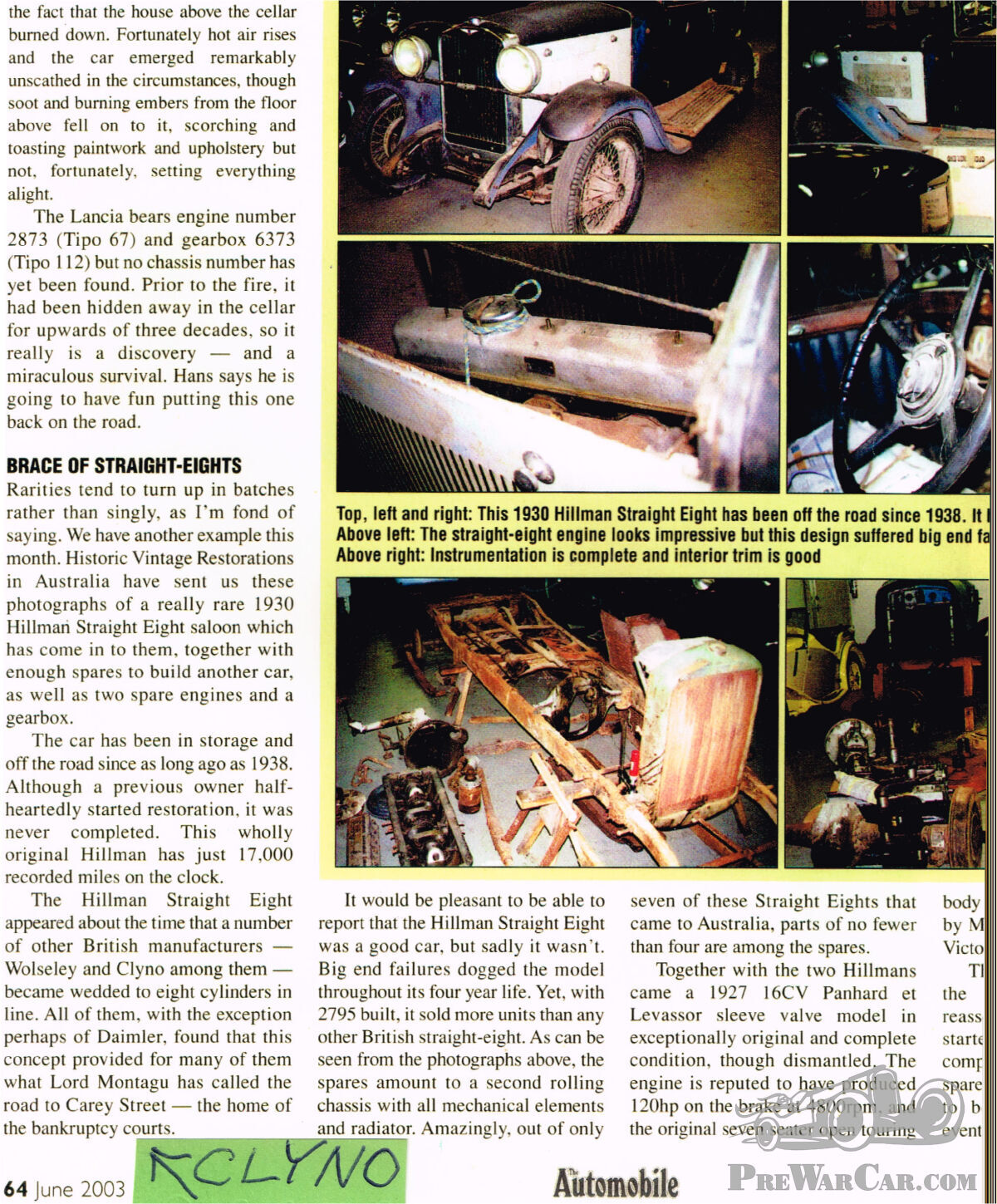
tony taylor
29 Juli 2019, 06:47
HI JIM,,, tony taylor BRISBANE, AUSTRALIA,,, i'am sending this to you as I have a 1929 Hillman straight 8 & a 1929 Hillman 14. my grandfathers car from new,, have plenty of paper work on this car,,, when I saw CLYNO it rang a bell & I went looking at my files,, I do remember reading about the name,, have looked from time to time to see if I could find any info,, but NO INFO,, they might have made a straight 8,, some-one might* know*. Tony ,, PS photo's of Hillman parts NOT MINE
Weiter lesen
Jim Gibson
01 August 2019, 23:56
Hi Tony,
Yes Clyno did make an 8-cylnder engine right at the end in 1928, but it never saw the light of day in a chassis apparently.
Many thanks for sending me the magazine page.
Cheers,
Jim
Weiter lesen
Yes Clyno did make an 8-cylnder engine right at the end in 1928, but it never saw the light of day in a chassis apparently.
Many thanks for sending me the magazine page.
Cheers,
Jim
I'd love to find out more about Clynos in Australia and will try and help if you have any questions. My father has always said the body was made by holdens and it has been in our family since the mid 50's when my mother would drive it to work. The family converted the dickie seat into a boot sometime in the late 50's.
Regards Greg