Das weltweite Magazin und der Marktplatz für Oldtimer-Enthusiasten – von Enthusiasten.
Das weltweite Magazin und der Marktplatz für Oldtimer-Enthusiasten – von Enthusiasten.


Filter
Auswahl treffen
- Autos
-
Marke >>
-
Baujahr >>
-
-
Kategorie >>
-
Länder >>
- Motorräder
-
Standort >>
- Teile
-
Automarke >>
-
Hersteller >>
-
Kategorie >>
- Fahrräder
-
Baujahr >>
-
Länder



Friday Lady's travels Down Under


Countries which don't have their own motor industries sometimes have the most interesting motoring landscapes, when cars are imported from all over the world in the absence of a native manufacturer. In the pre-war years, neither Australia nor New Zealand had enjoyed any sort of large-scale motor-manufacturing operation (Holden did not produce its first independently-designed car until 1948), so their streets were enlivened by a colourful mix of imports from both America and Britain.
If we've identified the number plate correctly, this picture was taken somewhere in New Zealand, the car being a 1937 Nash. Nash offered two models in 1937, the budget-priced LaFayette 400 and the more upmarket Ambassador. We're not sure exactly which this is, but perhaps somebody out there can let us know.
The smart lady looks quite proud to be standing alongside the car, although it's not hers. It belongs to one Mr. Robinson, but they must have been very good friends he's going to let her take his shiny new Nash for a spin. She's nicely attired for going shopping in town or meeting some friends for lunch, but if she really wants to secure a reputation as a woman of style and taste, striking a nonchalant pose behind the wheel of the Nash is sure to do it.
Words: Zack Stiling; picture: Stiling Collection
Publiziert:
Freitag Januar 27th, 2023
Facebook
LinkedIn
Twitter
WhatsApp
Email
Copy
Kommentare
Steve Diggins
01 Februar 2023, 00:07
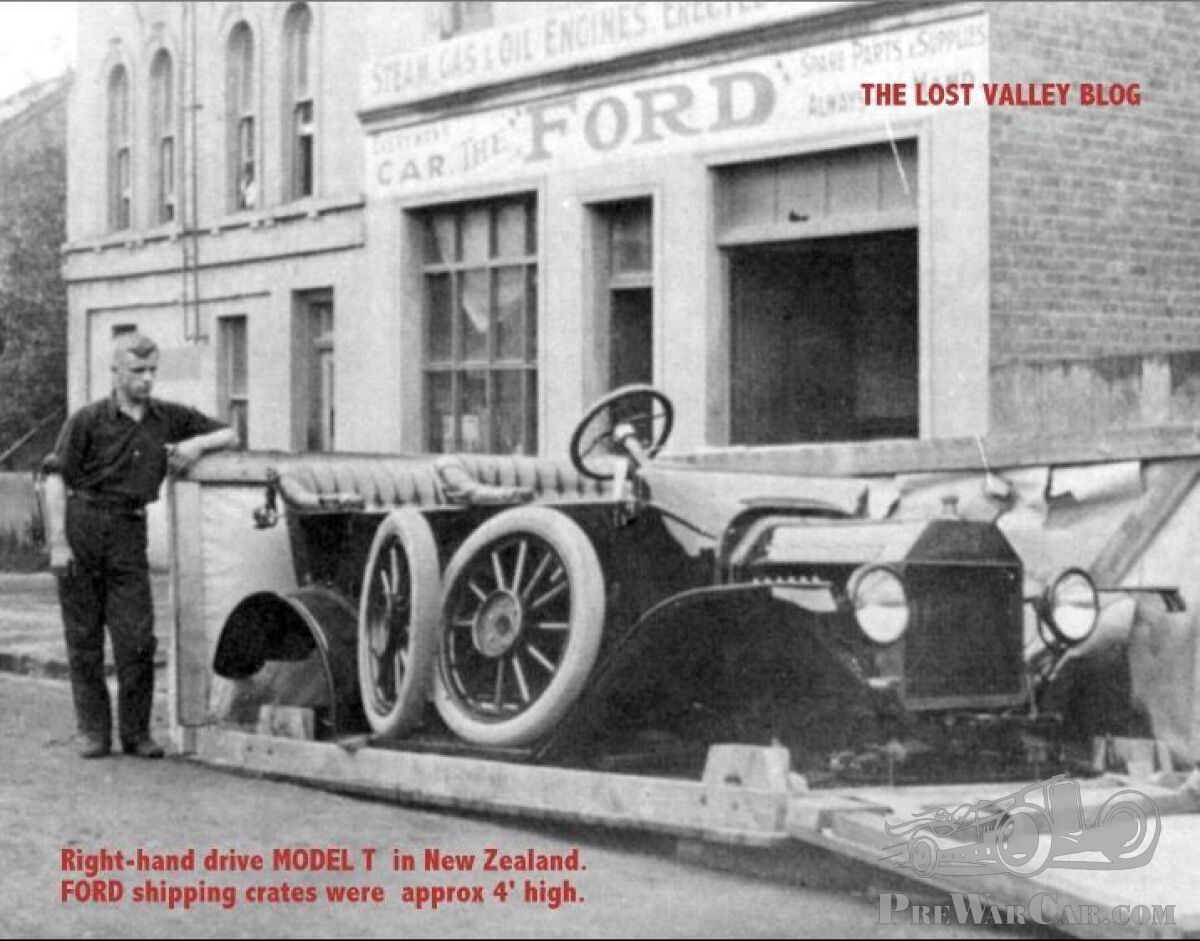
Here is a new Canadian-built Ford Model T which has just arrived in New Zealand.
Weiter lesen
Anthony Wilson
31 Januar 2023, 22:42
It certainly looks like New Zealand. In NZ in the '30s the plates were changed every year as part of the annual registration. The image of the plate is a bit small to confirm whether this is a 1937/38 plate (in which the divider between the two groups of three numbers was an upside down tear drop) or a 1938/39 plate (with a diamond divider). It can't be a 1939/40 plate as these were black letters on an orange background).
In respect of Steve Diggins's comments, the Australian-made bodies had much more timber in them than the Canadian bodies, presumably as they didn't have big presses. I have worked on both Australian and NZ (ex-Canadian) 1928 Ford Model A phaetons (tourers) and whereas the Australian cars have wooden frames, the Canadian ones only use wood as inserts to which the trim is nailed.
Weiter lesen
In respect of Steve Diggins's comments, the Australian-made bodies had much more timber in them than the Canadian bodies, presumably as they didn't have big presses. I have worked on both Australian and NZ (ex-Canadian) 1928 Ford Model A phaetons (tourers) and whereas the Australian cars have wooden frames, the Canadian ones only use wood as inserts to which the trim is nailed.
Jorge Pedro Bascoy
31 Januar 2023, 11:07
El automóvil es un Nash Ambassador 1037, motor 8 cilindros en linea y doble encendido
-----------------------------
The car is a Nash Ambassador 1037, eight-cylinder in-line engine and double ignition.
Weiter lesen
-----------------------------
The car is a Nash Ambassador 1037, eight-cylinder in-line engine and double ignition.
Steve Diggins
29 Januar 2023, 23:17
Actually, the majority of cars imported to Australia and New Zealand in the early nineteen hundreds were built in Canada. These cars had a high percentage of parts, materials and labor as Canadian content. Even the companies, which were incorporated in Canada, had a significant amount of shares owned by Canadians. This allowed the cars to be classified as 'Empire Products'. The Right Hand Drive cars were shipped to Empire countries around the world and did not require import duties to be paid. This involved cars such as Ford, Chevrolet, Buick, Studebaker, Overland, Packard, Russell, Chrysler and a few more to be sent around the world.
In 1923 the Australian government decided that all imported cars must be have bodies built in their country. In 1924 Ford opened a plant in Australia to do that. In the same year General Motors contracted the coach builder Holden to do the same job and opened a new plant. They both used Canadian built RHD chassis with drive lines. This lasted throughout the 1930's.
Weiter lesen
In 1923 the Australian government decided that all imported cars must be have bodies built in their country. In 1924 Ford opened a plant in Australia to do that. In the same year General Motors contracted the coach builder Holden to do the same job and opened a new plant. They both used Canadian built RHD chassis with drive lines. This lasted throughout the 1930's.
Ian Nott
29 Januar 2023, 20:48
Soon as I looked at it I knew it was New Zealand. Possibly, some where around Lower Hutt which is a sibling city to the capital Wellington.
Ian Nott
Auckland
New Zealand.
Weiter lesen
Ian Nott
Auckland
New Zealand.