Das weltweite Magazin und der Marktplatz für Oldtimer-Enthusiasten – von Enthusiasten.
Das weltweite Magazin und der Marktplatz für Oldtimer-Enthusiasten – von Enthusiasten.


Filter
Auswahl treffen
- Autos
-
Marke >>
-
Baujahr >>
-
-
Kategorie >>
-
Länder >>
- Motorräder
-
Standort >>
- Teile
-
Automarke >>
-
Hersteller >>
-
Kategorie >>
- Fahrräder
-
Baujahr >>
-
Länder



French (cycle) car makes of 100 years and older




Nobody can have missed thé centenary celebration of 2019. Citroën started making cars in 1919, in a factory founded by André Citroën where, during the First World War, armaments were produced. The Citroën company was not the only one in France which had to switch to other products after November 1918. The market for arms, artillery, aeroplanes, aviation engines and other war-related products had become much smaller.
For this article, I have tried to find all French companies which tried to find their luck on the growing automotive market. Before the war started, the growth of the number of private cars in France had been impressive: in 1910 about 60 thousand were counted, in 1914 this had risen to more than 107 thousand! The war had shown how indispensable cars and trucks had become and during the war years, many young men had become acquainted with cars, as a chauffeur, as a mechanic, or otherwise. When 1919 started there must have been a general feeling that the automobile would only become more important in everybody’s daily life and that there would be plenty of room in the automotive world for new manufacturers. Besides, Le Zèbre and some others had already shown before 1914 that building small cars was a profitable business. And Bédélia had shown that there was also a market for those rather spartan cyclecars. The French tax regulations for car owners also stimulated the interest in light vehicles.
Before I start to list all the 1919 makes I have found, one remark. If you look up these makes in the Beaulieu Encyclopedia (or Georgano’s Encyclopedia) you will notice that some of the manufacturers mentioned below did not start in 1919. One explanation for this discrepancy is related to the difficult question: which year do we take as the starting year of a car maker? Is it the moment when the first model was designed? When was the prototype finished? When the first car was sold on the market? When the company was formally founded?
Three groups
The ‘class of 1919’ can be divided into three groups, at least.
In the first group, there is a relationship with the world of aeroplanes. There we find Farman, a name strongly related to the pioneering days of aviation. An even more famous name of those days was Voisin. The famous fighter pilot René Fonck also started to design a car after the Great War (which was only presented in 1920). Not more than a dozen of his expensive automobiles seem to have been built. The production of the Gnome et Rhône was even smaller with two complete cars and a chassis; its engine was even bigger than that of the Farman and Fonck. Secqueville & Hoyau had produced aero engines before the war. And then there is the electric A.A.A., in most automotive encyclopedias the very first make. The abbreviation stands for Ateliers d'Automobile et d'Aviation, which suggests this company had a link with aviation too. But it remains obscure which.
The second group is that of the small companies which tried their luck in the booming market for cyclecars. Before the war, this market was still small and was dominated by Bédélia. In 1919 the following cyclecar makes appeared: Ajams (or Ajam according to the Beaulieu Encyclopedia), Aviette (obscure), Cyclauto (a three-wheeler), De Marçay (an interesting attempt, see www.demarcay.de), Éclair, Elfe (very original but not very successful racers), Godet (also a three-wheeler), Janemian (very original, presented by an Armenian), Major (one of the many makes supported by Marcel Violet), M.S., Sky, S.U.P., Tic-Tac, and Tom Pouce.
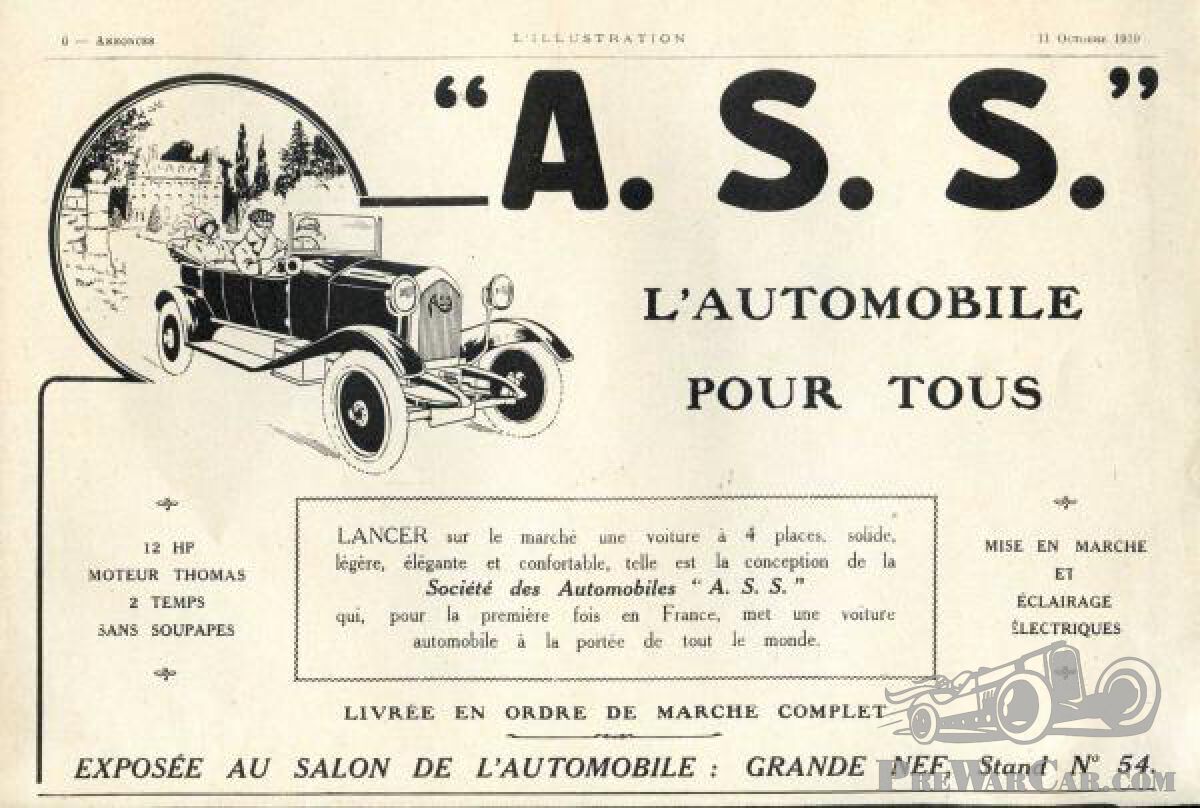
And finally, there is a third ‘group’ of makes which only have in common that they seem to have tried seriously to enter the market of ordinary or even popular private cars. Without much success. In this group, we find A.S.S. (with two-stroke engine), Butterosi (which even tried to enter the American market), Delpeuch, Fonlupt, La Marne, and SIX (one of the few makes from Strasbourg).
Of all the makes mentioned above, only Voisin, Farman and Major managed to survive for more than a decade. And only Voisin and Secqueville & Hoyau managed to produce a substantial number of cars (about 500 in case of S & H). Remarkably these three all offered rather or highly luxurious models. All the cyclecar builders never reached any significance. For some, this could be explained by the fact that the market for cyclecars was still very small in 1919. According to the magazine Moto Revue the number of cyclecars in France was only 814 in 1920. During the 1920s the choice between a ‘real’ car like the first Citroën models and the small and often hard to handle cyclecars was usually decided in favour of the first. And the makers from the third group? Their fate would be worth some further study but they may just have been unlucky. The Depression of 1920-1921 may have been one of the causes of their failure.
Words by Fons Alkemade.
Publiziert:
Sonntag Mai 17th, 2020
Facebook
LinkedIn
Twitter
WhatsApp
Email
Copy
Kommentare
Fons Alkemade
19 Mai 2020, 21:24
Svend Algren Nielsen
13 Mai 2024, 21:13
I am searching for information on ALBA cars. Perhaps they were Belgian, or perhaps French? Can you help me?
Kind regards,
Svend Algren
Weiter lesen
Kind regards,
Svend Algren
Mathieu G
17 Mai 2020, 13:58
Hello, Thanks for this picture moteur à ailettes système EP !
I think it is the engine built by Emile Petit, the engineer of the Salmson engines !
Very close to the 4 pusrods engine in Salmson AL and VAL.
Weiter lesen
I think it is the engine built by Emile Petit, the engineer of the Salmson engines !
Very close to the 4 pusrods engine in Salmson AL and VAL.
There is not much information about this interesting concept of the Godet.
The Beaulieu Encyclopedia tells us it was a threewheeler but in fact it had two jumellated rear wheels.
It also tells us the engine was an Anzani but I don't know whether that is correct.
On the chassis presented at the 1919 Salon one could read that the engine had a special 'ailettes' system called E.P. What could they have meant by these 'winglets'?