Das weltweite Magazin und der Marktplatz für Oldtimer-Enthusiasten – von Enthusiasten.
Das weltweite Magazin und der Marktplatz für Oldtimer-Enthusiasten – von Enthusiasten.


Filter
Auswahl treffen
- Autos
-
Marke >>
-
Baujahr >>
-
-
Kategorie >>
-
Länder >>
- Motorräder
-
Standort >>
- Teile
-
Automarke >>
-
Hersteller >>
-
Kategorie >>
- Fahrräder
-
Baujahr >>
-
Länder



Bekämpfung der Salzgefahr: Die vorgekriegszeitliche Lösung für Winterfahrten
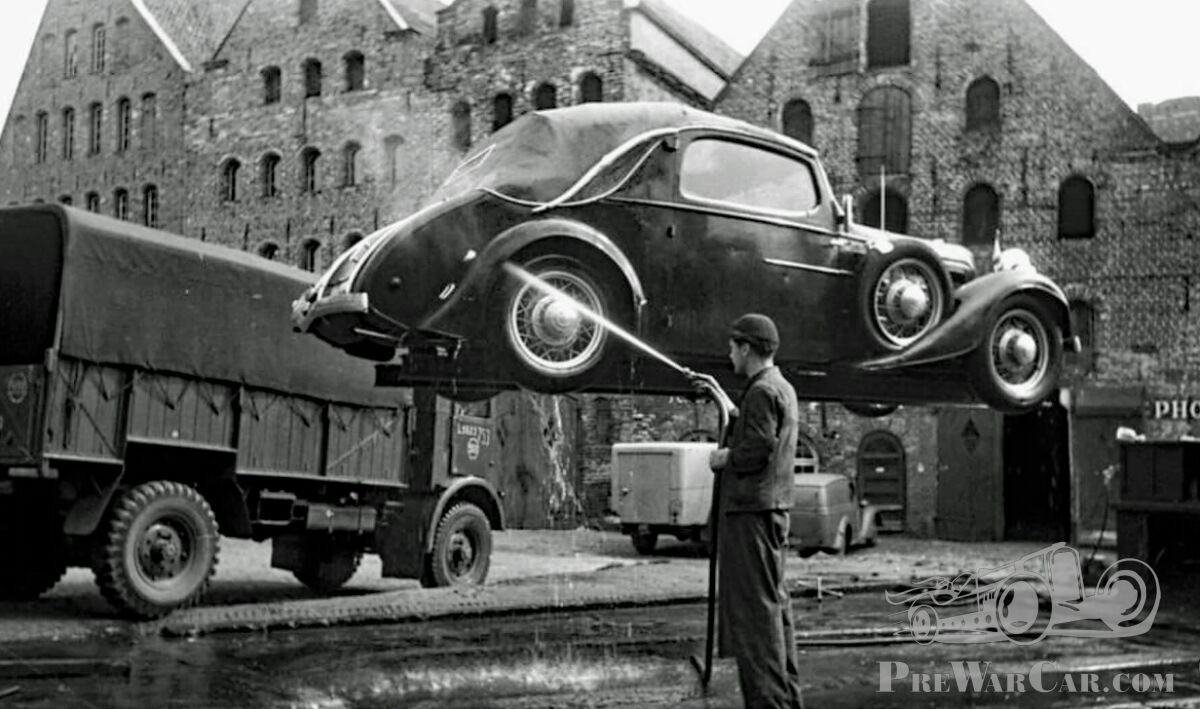

Nein, das ist kein Trick! Schauen Sie genau hin und Sie werden sehen, dass das Auto nicht in der Luft schwebt, sondern sich tatsächlich auf einem Aufzug mit einer zentralen Stange befindet, die nur von dem Mann vor dem Schlauch verdeckt wird. Ganz schön clever!
Das Foto wurde in der Stadt Lübeck im Norden Deutschlands zu einem unbekannten Zeitpunkt aufgenommen. Wir wissen, dass die Gebäude im Hintergrund die historischen Salzlager der Stadt sind, die aus dem 16. bis 18. Jahrhundert stammen, als Lübeck ein wichtiger Handelspartner im Salzhandel war. Nebenbei bemerkt: Diese Gebäude wurden später als Unterschlupf des Grafen Orlok genutzt, als der berühmte Horrorfilm Nosferatu dort 1922 gedreht wurde. Einige der Gebäude im Erdgeschoss wurden später zu Garagen umgebaut. Sie existieren noch immer und können heutzutage für Veranstaltungen und Konzerte gemietet werden.
Jedenfalls, wenn wir Autoliebhaber an Salz denken, ist das erste, was uns in den Sinn kommt, das Streusalz, das im Winter auf den Straßen verteilt wird. Wir schaudern alle, wenn wir unsere Autos auf salzigen Straßen fahren müssen, also scheint dieses Bild ziemlich passend – spritzen Sie es einfach auf diesen cleveren Aufzug!
Was das Auto betrifft, gibt es keinen Zweifel daran, dass es ein Produkt deutscher Ingenieurskunst ist, aber welches genau?
Worte: Jeroen Booij
Fotografie: Scheerer Foto
Publiziert:
Montag Januar 6th, 2025
Facebook
LinkedIn
Twitter
WhatsApp
Email
Copy
Kommentare
Gerd Klioba
08 Januar 2025, 08:26
The car in front of the salt warehouses in Lübeck is a 1932 Ford V8 Aero-Cabriolet bodied by Ludewig.
Weiter lesen
Tim Hewitt
06 Januar 2025, 23:31
I'm not sure what the car is, but the truck is definitely a British Army Austin K5 with a GS body. They made just over 12,000 of them between 1941 and 1945.
By the way, the spare wheel on the car won't do them much good; it looks flat to me.
Weiter lesen
By the way, the spare wheel on the car won't do them much good; it looks flat to me.
David Grimstead
06 Januar 2025, 22:02
I don’t know about the car but the “elephant-in-the-parkplatz” for truck enthusiasts looks like a British Second World War-era Austin K5 4x4 army lorry, known as a “screamer” due to its noisy transfer box, not to mention its dodgy piston rings.
A number of post-war armies got surplus ones free; notably this included a Norwegian Army unit of 4,400 men, which was moved from the Harz area to Schleswig-Holstein (with Lübeck at its edge) to secure some of the British occupation zone between September, 1948, and 1953—the Russian zone started a few miles east of Lübeck.
Information about the Norwegian unit says that “a number of administrative vehicles of German origin were also allocated”—could the wing-mounted standard that Dirk Eger mentions be a Norwegian flag on the C.O.’s personal staff car?
I must add that the Danish Army got some K5s, too, and their door-printed registration numbers start as here with “L.”
Looking at the style of the two commercial vans, this must be early 1950s rather than pre-war.
Weiter lesen
A number of post-war armies got surplus ones free; notably this included a Norwegian Army unit of 4,400 men, which was moved from the Harz area to Schleswig-Holstein (with Lübeck at its edge) to secure some of the British occupation zone between September, 1948, and 1953—the Russian zone started a few miles east of Lübeck.
Information about the Norwegian unit says that “a number of administrative vehicles of German origin were also allocated”—could the wing-mounted standard that Dirk Eger mentions be a Norwegian flag on the C.O.’s personal staff car?
I must add that the Danish Army got some K5s, too, and their door-printed registration numbers start as here with “L.”
Looking at the style of the two commercial vans, this must be early 1950s rather than pre-war.
Francisco Carrión
06 Januar 2025, 19:08
They're clearly Ford V8 bumpers and wheels. I think it is a German-bodied Ford V8, a very interesting one-off car.
Weiter lesen
Daniel Reuben
06 Januar 2025, 12:38
I vote for an Audi UW220. I think the hubcaps, the shape of the wings and the impressed beltline on the upper side of the bonnet which bends down at an angle at the very front all fit the Audi. I am having a hard time recognising the rear bodywork extending beyond the wings, the landau bars/top (is it just decorative—the fabric looks supported to be operational?) and also the horizontal trim piece on the door. Could this be special coachwork?
Weiter lesen
Dirk Eger
06 Januar 2025, 11:16
It is a Horch 853, probably confiscated by the British Army in 1945. You see the standard on the front wing.
Weiter lesen