Das weltweite Magazin und der Marktplatz für Oldtimer-Enthusiasten – von Enthusiasten.
Das weltweite Magazin und der Marktplatz für Oldtimer-Enthusiasten – von Enthusiasten.


Filter
Auswahl treffen
- Autos
-
Marke >>
-
Baujahr >>
-
-
Kategorie >>
-
Länder >>
- Motorräder
- Teile
-
Automarke >>
-
Hersteller >>
-
Kategorie >>
- Fahrräder
-
Baujahr >>
-
Länder



Fascinating Friday Lady street scene
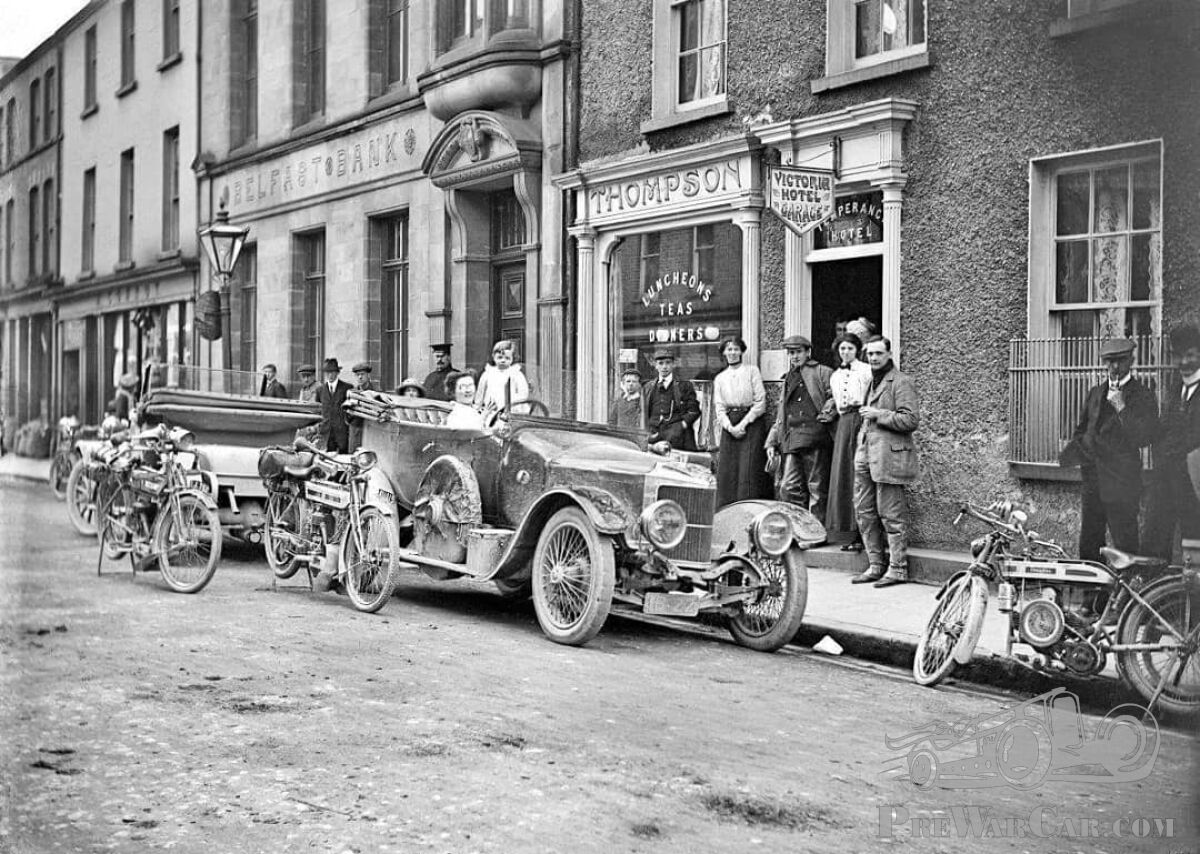

Wow. There is a lot to see in this image. Let’s start with the street itself. The Belfast Bank is clearly visible, which certainly helps in putting a location to it. It’s not this famous Belfast Bank building, though, almost fully destroyed in a devastating fire last year. Is it Belfast at all? It isn’t. A bit more sleuthing teaches us that the Thompson Victoria Hotel was located in Strabane, northern-Ireland and – yes – the Belfast Bank had a branch next to that – see here. Do these buildings survive?
What we like in particular is that the Thompson Victoria, apart from serving luncheons, teas and dinners, also used to be a garage. And they must have been busy times around 1910 we think. In front of the entrance, we see two cars, three motorcycles and eighteen people looking into the camera. Centre of attention – to the onlooker at least – is the lady in the front car, who is holding up a child. What were they doing and why do they have such a gathering of people around them? Any information about the cars and bikes is welcome. Is that first car with its ‘wraparound’ radiator registered IB-22? A Vauxhall Prince Henry? We would love to learn a little bit more.
Words by Jeroen Booij. Picture Herbert F. Cooper / The Public Record Office of Northern Ireland.
Publiziert:
Freitag November 1st, 2019
Facebook
LinkedIn
Twitter
WhatsApp
Email
Copy
Kommentare
Jeroen Booij
12 November 2019, 09:42
Some impressive research carried out here by readers. Well done to all, and David Green in particular!
Weiter lesen
Kieran White
05 November 2019, 23:55
My source was the IMD of 1913 and the name quoted was Mac Lean.
As registrations in Ireland were introduced for the 1905 season my guess is IB 22 may have been on an earlier car.
It was not uncommon for families to retain a registration for years despite changes in their cars. An example the the Gabbett/Knox family of Ballaghtobin, Callan Co. Kilkenny. The family number was IP 1 , once on a 1907 Holman Coatalen 25HP ( possibly a 2nd application) and ending up on a 1937 Hillmam Minx.
A further complication was the fact that IP 1 was contemporaneously used on a motorcycle! ( pers com Mickey Gabbett).
This was allowed in some Irish counties.
Weiter lesen
As registrations in Ireland were introduced for the 1905 season my guess is IB 22 may have been on an earlier car.
It was not uncommon for families to retain a registration for years despite changes in their cars. An example the the Gabbett/Knox family of Ballaghtobin, Callan Co. Kilkenny. The family number was IP 1 , once on a 1907 Holman Coatalen 25HP ( possibly a 2nd application) and ending up on a 1937 Hillmam Minx.
A further complication was the fact that IP 1 was contemporaneously used on a motorcycle! ( pers com Mickey Gabbett).
This was allowed in some Irish counties.
A. Bos
05 November 2019, 12:40
Impressive piece of research, David, hats off! They say: if images could speak ... Maybe they don't, but you only need someone to speak for them!
Weiter lesen
David GREEN
05 November 2019, 09:15
I have undertaken some further research over the weekend on last Friday's photograph, which I will summarise briefly the results under 4 headings: the car, the owner, a possible scenario for the photograph, and Thomas Andrews.
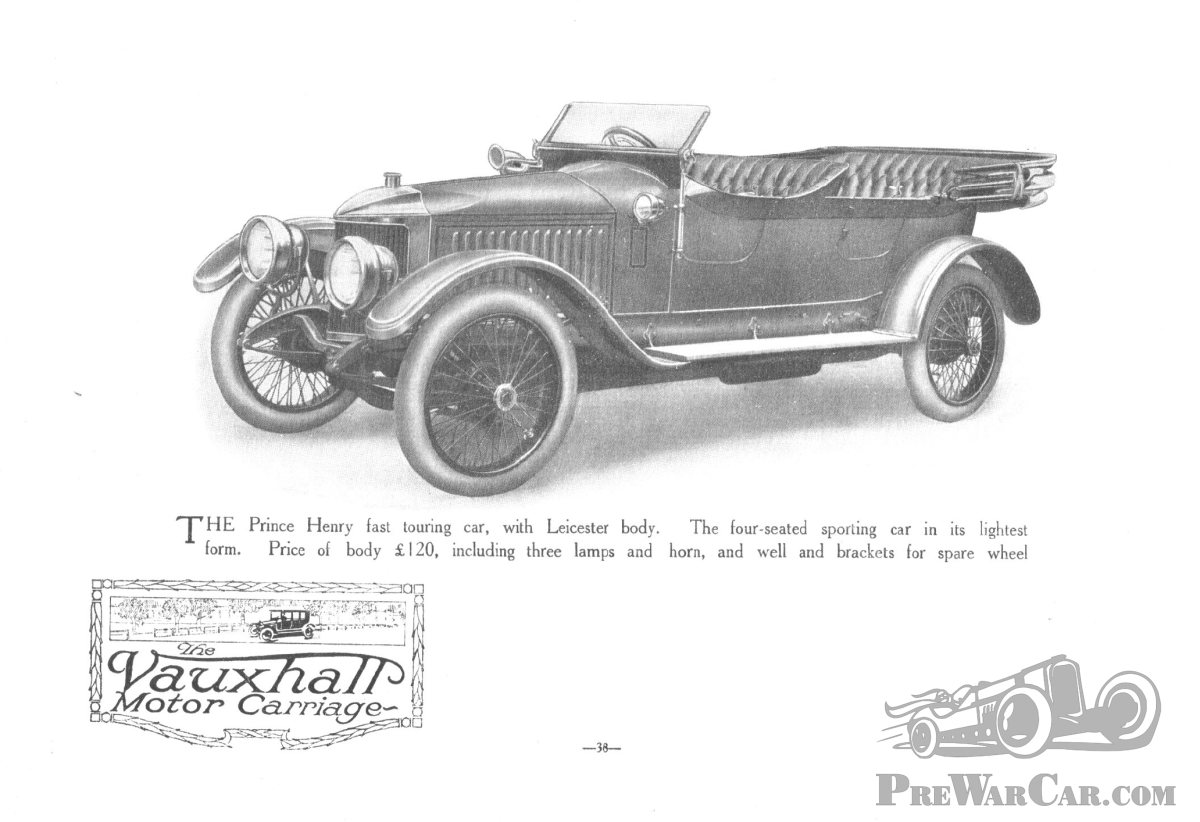
The car: Irish registrations for the relevant period are covered in 'The Irish Motor Directory', which was published annually. I have only had access to the 2nd edition for 1914-1915, where IB22 is listed as registered to Francis H MacLeod, of Ceana, Windsor Avenue, Belfast. Earlier versions of the IMD should immediately identify when it was first registered. I have also consulted the Vauxhall sales brochure for 1914, available from the Vauxhall Register. This shows three available models of the Prince Henry: the Brooklands, the Leicester, and the Denbigh. The car bodywork in Friday's photograph is similar to, but not identical to, the Leicester. The sunken cross-member is clearly visible (see attachment), consistent with a 1914 dating, but possibly consistent with earlier datings.
The owner: MacLeod is an unusual surname in Ireland, and is easy to follow in the archives. Francis Hugh Macleod was born in early 1889 to a farming family living at Glenanne, halfway between Armagh and Newry. He had an older sister, Margaret, and a younger brother, Thomas. Their aunt was Mary Moore Harrison, a childless widow and the owner of Ceana, Windsor Avenue, Belfast. She appears to have been very wealthy. Her house, number 26, had 13 rooms, the largest number in a street of large houses. Several others had 10 rooms. The three MacLeod children were living with her in Belfast at the time of the 1901 census, and were described as scholars, suggesting they had been sent from rural Armagh for their better schooling. Francis was married in 1913 and joined the Irish Constabulary in 1914. Three cars appear to have been bought at about the same time and registered to occupants of Ceara: IB13 to Thomas, IB20 to Mrs Harrison and IB22 to Francis. The obvious person who was wealthy enough to buy three cars, including a Prince Henry, was Mrs Harrison. The IMD for 1914 has 490 entries for County Armagh, suggesting the cars were bought not long after the introduction of registration (in 1910?). I assume they were registered in Armagh for family reasons, since Windsor Avenue is in Antrim.
A possible scenario for the photograph: The centre of attention in the photograph is clearly the mother and child. Assume the young woman is Mrs Francis MacLeod. Assume she became pregnant shortly after her marriage; the baby came in 1914 and is about 3 years old in the photo. That would date the photo to 1917. I can find no direct connection to the Victoria Temperance Hotel, which was run by Miss Victoria Thompson throughout the relevant period. I assume she had a connection with the young couple, possibly an aunt. Something was needed to justify the journey from Belfast, to which the mud on the Prince Henry testifies. Perhaps Francis MacLeod is one of the two men in the main group?
Thomas Andrews: This was an unexpected surprise. Andrews lived at number 20 Windsor Avenue and was therefore a near neighbour of Mrs Harrison. He was the principal naval architect of the Titanic, which was built at the yards of Harland & Wolff in Belfast. His uncle was Viscount Pirrie, the chairman and part owner of Harland & Wolff, and two of his brothers were Prime Minister and Lord Chief Justice respectively of Northern Ireland, confirming that Windsor Avenue was for the wealthy and well-connected. Sadly, Andrews went down with the ship he had designed. It should be placed on record that he wanted 46 lifeboats, not the 20 fitted; the ship to be double-hulled; and with higher bulkheads, but was overruled.
I am indebted to databases held by The National Archives of Ireland and Lennon Wylie (www.lennonwylie.co.uk) for information, without which this level of research would not have been possible.
Weiter lesen
The car: Irish registrations for the relevant period are covered in 'The Irish Motor Directory', which was published annually. I have only had access to the 2nd edition for 1914-1915, where IB22 is listed as registered to Francis H MacLeod, of Ceana, Windsor Avenue, Belfast. Earlier versions of the IMD should immediately identify when it was first registered. I have also consulted the Vauxhall sales brochure for 1914, available from the Vauxhall Register. This shows three available models of the Prince Henry: the Brooklands, the Leicester, and the Denbigh. The car bodywork in Friday's photograph is similar to, but not identical to, the Leicester. The sunken cross-member is clearly visible (see attachment), consistent with a 1914 dating, but possibly consistent with earlier datings.
The owner: MacLeod is an unusual surname in Ireland, and is easy to follow in the archives. Francis Hugh Macleod was born in early 1889 to a farming family living at Glenanne, halfway between Armagh and Newry. He had an older sister, Margaret, and a younger brother, Thomas. Their aunt was Mary Moore Harrison, a childless widow and the owner of Ceana, Windsor Avenue, Belfast. She appears to have been very wealthy. Her house, number 26, had 13 rooms, the largest number in a street of large houses. Several others had 10 rooms. The three MacLeod children were living with her in Belfast at the time of the 1901 census, and were described as scholars, suggesting they had been sent from rural Armagh for their better schooling. Francis was married in 1913 and joined the Irish Constabulary in 1914. Three cars appear to have been bought at about the same time and registered to occupants of Ceara: IB13 to Thomas, IB20 to Mrs Harrison and IB22 to Francis. The obvious person who was wealthy enough to buy three cars, including a Prince Henry, was Mrs Harrison. The IMD for 1914 has 490 entries for County Armagh, suggesting the cars were bought not long after the introduction of registration (in 1910?). I assume they were registered in Armagh for family reasons, since Windsor Avenue is in Antrim.
A possible scenario for the photograph: The centre of attention in the photograph is clearly the mother and child. Assume the young woman is Mrs Francis MacLeod. Assume she became pregnant shortly after her marriage; the baby came in 1914 and is about 3 years old in the photo. That would date the photo to 1917. I can find no direct connection to the Victoria Temperance Hotel, which was run by Miss Victoria Thompson throughout the relevant period. I assume she had a connection with the young couple, possibly an aunt. Something was needed to justify the journey from Belfast, to which the mud on the Prince Henry testifies. Perhaps Francis MacLeod is one of the two men in the main group?
Thomas Andrews: This was an unexpected surprise. Andrews lived at number 20 Windsor Avenue and was therefore a near neighbour of Mrs Harrison. He was the principal naval architect of the Titanic, which was built at the yards of Harland & Wolff in Belfast. His uncle was Viscount Pirrie, the chairman and part owner of Harland & Wolff, and two of his brothers were Prime Minister and Lord Chief Justice respectively of Northern Ireland, confirming that Windsor Avenue was for the wealthy and well-connected. Sadly, Andrews went down with the ship he had designed. It should be placed on record that he wanted 46 lifeboats, not the 20 fitted; the ship to be double-hulled; and with higher bulkheads, but was overruled.
I am indebted to databases held by The National Archives of Ireland and Lennon Wylie (www.lennonwylie.co.uk) for information, without which this level of research would not have been possible.
Kieran White
02 November 2019, 00:26
IB 22, a County Armagh number was registered to Francis H. MacLean, Clara, Windsor Avenue, Belfast.
Weiter lesen
David GREEN
01 November 2019, 20:31
Like Ariejan Bos, I am not an authority on Edwardian and vintage Vauxhalls. But there are a couple of points I would make. The first is about the number plate which, I agree, is IB 22. The letters I and Z are only legal on Northern Ireland registrations, and IB is County Armagh. Registrations only started in 1909-1910, so that IB 22 is moderately early. Ireland was not partitioned at the time, but Armagh was in the province of Ulster and became one of the counties making up Northern Ireland. Strabane is, of course, in County Tyrone.
Now to the car, which presents some puzzles. It is undoubtedly a Prince Henry, but the normal front cross-bar between the frames is missing. Instead, there is a pressed bar that drops with 45° angles to a flat plane. This arrangement was introduced at the same time as the new D-type radiator, which sits snugly on the pressed bar. The wheelbase is difficult to assess but it looks to be the shorter Prince Henry-type, not the longer D-type. The bonnet is also Prince Henry-type (short bonnet flutes). The headlights are not the normal bell-shaped CAV F-type, but may be the E-type as fitted to the D-type models. Finally, the mudguards are very similar to the standard War Department staff car D-types. All-in-all, it looks like a late example of a Prince Henry (1914?) with some transitional features. The engines were effectively the same (25HP, identical cylinder dimensions) but I gather that later D-types used a de-tuned version.
Weiter lesen
Now to the car, which presents some puzzles. It is undoubtedly a Prince Henry, but the normal front cross-bar between the frames is missing. Instead, there is a pressed bar that drops with 45° angles to a flat plane. This arrangement was introduced at the same time as the new D-type radiator, which sits snugly on the pressed bar. The wheelbase is difficult to assess but it looks to be the shorter Prince Henry-type, not the longer D-type. The bonnet is also Prince Henry-type (short bonnet flutes). The headlights are not the normal bell-shaped CAV F-type, but may be the E-type as fitted to the D-type models. Finally, the mudguards are very similar to the standard War Department staff car D-types. All-in-all, it looks like a late example of a Prince Henry (1914?) with some transitional features. The engines were effectively the same (25HP, identical cylinder dimensions) but I gather that later D-types used a de-tuned version.
Henry Smith
01 November 2019, 12:53
Unfortunately the buildings no longer exist. The Provincial bank building on the other side of the road still stands, but the Belfast Bank building has been replaced with a new bank building and the Thompsons hotel is a modern shop building.
Weiter lesen
Lance Milne
01 November 2019, 12:08
The car facing away from the camera has a distinctive rear axle, surely the veteran experts can idenrify it !
Weiter lesen
A. Bos
01 November 2019, 09:59
Interesting photo and indeed a lot to see! The word 'Garage' in this context however will undoubtedly have been used in the old sense of storing or parking cars and cycles. It was used in the sense of workshop only much later, though I guess that was a gradual transition. The word is derived from the french 'garer', which means to store things. So parking lots in France were already soon called 'garage' and many hotels used it to attract the new generation of motorized tourists.
Another word which triggered me was the word 'Temperance' above the entrance door. Some googling revealed that this hotel was part of the movement against alcohol abuse. The temperance movement was part of the struggle against alcohol abuse around the turn of the century, like we know from so many other countries.
Finally about the car. I'm not a Vauxhall expert, so I would like to know if the horizontal dividing bar on the radiator core may be used as a dating tool. One of the oldest Prince Henry Vauxhalls still in existence (of 1910) has even three bars, but going through my archive I notice also two bars. Generally it seems that the older, the more bars. If this is true, then the photo has to be dated at 1913 or even later. So who knows?
Weiter lesen
Another word which triggered me was the word 'Temperance' above the entrance door. Some googling revealed that this hotel was part of the movement against alcohol abuse. The temperance movement was part of the struggle against alcohol abuse around the turn of the century, like we know from so many other countries.
Finally about the car. I'm not a Vauxhall expert, so I would like to know if the horizontal dividing bar on the radiator core may be used as a dating tool. One of the oldest Prince Henry Vauxhalls still in existence (of 1910) has even three bars, but going through my archive I notice also two bars. Generally it seems that the older, the more bars. If this is true, then the photo has to be dated at 1913 or even later. So who knows?
Anders Svenfelt
01 November 2019, 05:58
Yes, I think it's a Vauxhall C-Type "Prince Henry" made from 1911 onwards. Is the motorcycle at the right perhaps a Douglas twin of about the sam vintage?
Weiter lesen