Das weltweite Magazin und der Marktplatz für Oldtimer-Enthusiasten – von Enthusiasten.
Das weltweite Magazin und der Marktplatz für Oldtimer-Enthusiasten – von Enthusiasten.


Filter
Auswahl treffen
- Autos
-
Marke >>
-
Baujahr >>
-
-
Kategorie >>
-
Länder >>
- Motorräder
- Teile
-
Automarke >>
-
Hersteller >>
-
Kategorie >>
- Fahrräder
-
Baujahr >>
-
Länder



Dutch bulb trader in a mystery car


Letter to the editor
Can anyone tell me what car this is and from what year approximately?
It is a Dutch bulb trader in England around 1925.
Publiziert:
Dienstag April 6th, 2021
Facebook
LinkedIn
Twitter
WhatsApp
Email
Copy
Kommentare
David Grimstead
03 April 2021, 14:14
Ariejan Bos
05 April 2021, 21:43
This is a nice piece of research and I will not dispute your knowledge. However it doesn't explain the round top of the radiator of the car. In 1915 the top of the bonnet had been levelled with the top of the radiator, but the shape of the radiator shell remained the same though with rounded corners. This situation continued till at least 1919. So the radiator with round top must date either from after 1919, or it was a non-standard model.
Weiter lesen
David Grimstead
06 April 2021, 14:48
Nick Georgano’s Beaulieu Encyclopaedia on the Singer 10 light car, says: “Manufacture continued at least up to 1916 as it was used by the armed forces, the 1915 models having rounded radiators and electric lighting”. Another modern writer also noted that “the rounded-off radiator was introduced at the end of 1914 for the coming year”.
Advertisement illustrations from in 1914 do show the radiator with an angled top and curved shoulders but by March 1915 it is drawn smoothly curved over the top and adverts and photos after spring 1915 also show the bigger tail. It would probably have a split screen after 1919 and most adverts by then also show disc wheels, Sankey’s probably still an option.
Weiter lesen
Advertisement illustrations from in 1914 do show the radiator with an angled top and curved shoulders but by March 1915 it is drawn smoothly curved over the top and adverts and photos after spring 1915 also show the bigger tail. It would probably have a split screen after 1919 and most adverts by then also show disc wheels, Sankey’s probably still an option.
Ariejan Bos
06 April 2021, 18:53
I'm afraid the only way to convince me is to show a picture of a similar car. I tried to find one, but didn't succeed.
Weiter lesen
Ariejan Bos
01 April 2021, 11:14
As I already indicated, these light cars all had a more or less similar appearance, but: the Swift light car did not have a rounded radiator top and always had louvres in the bonnet side. And also: no hole for the steering gear!
Weiter lesen
Ariejan Bos
30 März 2021, 14:14
The English light car built around WW1 was built by so many makes, that it seems impossible to know how many. They resembled each other in many ways, differing by make and by year in many small details. They loved this type of steel wheels (often changing to disc wheels after the war), the cycle-type of mudguards and many used this type of hand grip.
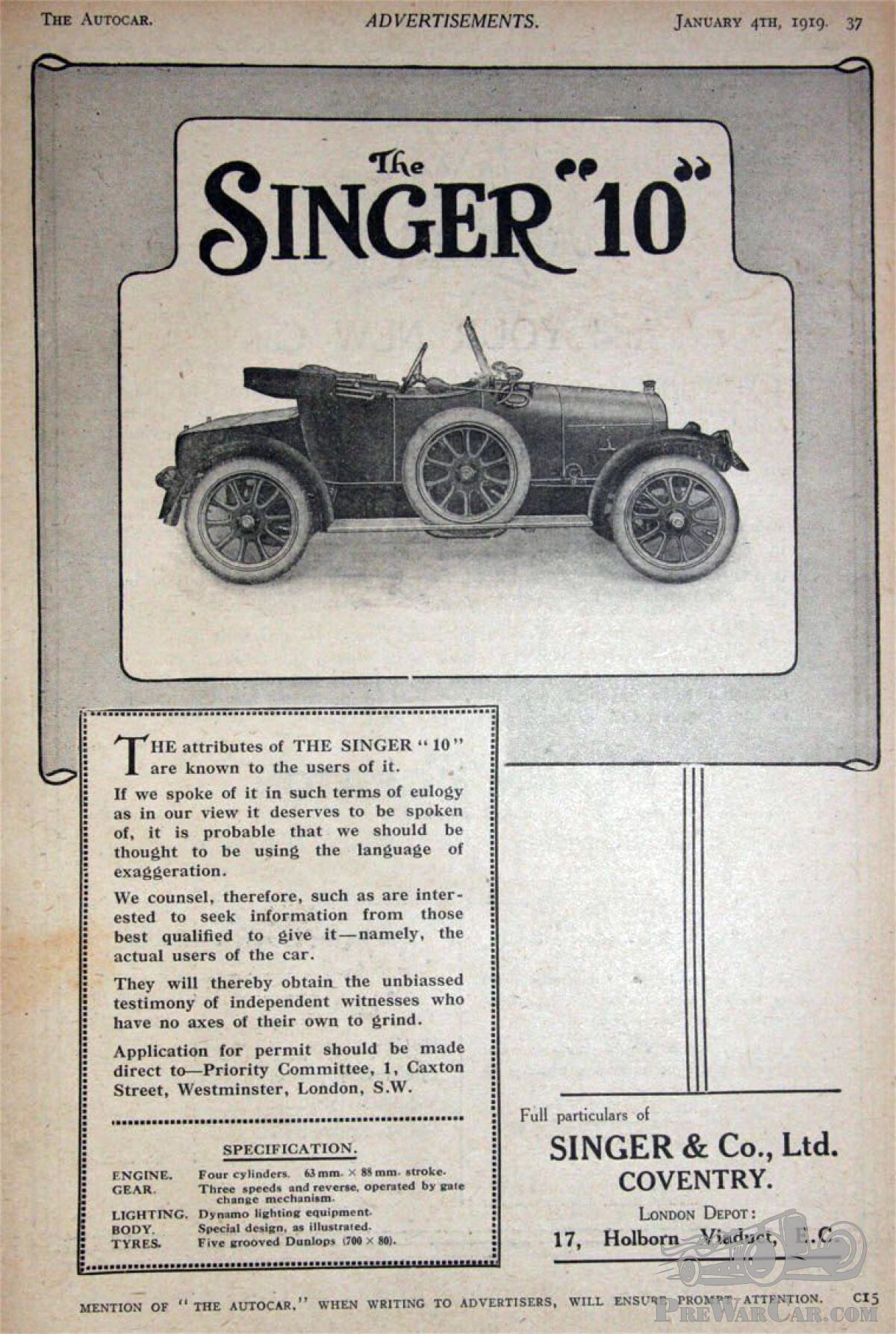
These little cars are not a part of my direct memory, and I needed to dive into my archive. It can be frustrating to search in this vast amount of makes and models, especially when you're looking for that seemingly important, because discriminating detail: the half circle opening cut in the bonnet for the steering gear. And just when you think it doesn't exist (in my archive, of course), it appears to be an 'ordinary' Singer of about 1919 (see uploaded ad, from Grace's Guide). Small differences can be found in the angle of the trunk and the shape of the radiator, but the latter changed at the end of that year. So probably we see a 1920 model. Certainly a Singer specialist will know.
Weiter lesen
These little cars are not a part of my direct memory, and I needed to dive into my archive. It can be frustrating to search in this vast amount of makes and models, especially when you're looking for that seemingly important, because discriminating detail: the half circle opening cut in the bonnet for the steering gear. And just when you think it doesn't exist (in my archive, of course), it appears to be an 'ordinary' Singer of about 1919 (see uploaded ad, from Grace's Guide). Small differences can be found in the angle of the trunk and the shape of the radiator, but the latter changed at the end of that year. So probably we see a 1920 model. Certainly a Singer specialist will know.
Michael Schlenger
31 März 2021, 00:12
Excellent job, Ariejan, as usual! I wouldn't have thought of a postwar model, at all...
Weiter lesen
Michael Schlenger
30 März 2021, 00:36
The car bears some similarities with "Brennabor" cars from c.1910 which were made in Brandenburg (Germany). Distinctive features are the shape and the position of the handle in the middle of the engine hood as well as the very sober design of the front wing. Perhaps this car was equipped with a more modern body later.
Weiter lesen
As well as munitions, they supplied a military version of the car, “the Army Officer’s Favourite”, which was widely used in Belgium and France. These were lower-geared (max. 40 M.P.H.) and khaki with black wings. Some new Singer Light Cars, presumably with updated specifications, were made available throughout the war years for private sale to key workers who held a permit from the government.
This probably 1914-15 model has the “3-1-1-1-3” pattern of paired rivets along the bonnet side seam, which were clearly depicted by artists in Singer’s advertising illustrations. For 1915, the radiator and bonnet were reshaped as per this one and the tail was later enlarged for the dickey seat. This one appears to have a 1914 short tail with a spring 1915 radiator/bonnet. Basic models were painted Elephant Grey or Stone Grey.
It was made before November 1919 when Singer were one of the first to fit Triplex Safety-glass to a new horizontally-split windshield that replaced the raked one-piece. Post-war Singers for unrestricted private sale were advertised “available to order” from January 1919 but possibly not deliverable until after August.